Showing posts with label Tecumseh. Show all posts

Saturday, September 21, 2019

Tecumseh -- How Did the Legend and the Dream Die?


“Tecumseh's skin was bullet-proof. When he went into battle, he always wore a white deer-skin hunting shirt, around which was girt a strap. The bullets shot at him would go through his shirt, and fall harmless inside. When the weight of the bullets inside the shirt became too great, he would unstrap his belt and let them fall through to the ground. He was a brave man, as a man whom bullets could not wound would of course be; he never used a gun in battle, only a hatchet.

“Tecumseh had but one son. One day, when the great warrior had grown old and feeble, he called his son to him and said: 'I am getting old. I want to leave you what has made me proof against bullets.' Thereupon Tecumseh commenced to retch, and try to vomit. He repeated this several times and finally threw up a smooth, black stone, about three inches long.

“That stone was Tecumseh's soul. Handing it to his son, he said: 'I could not be killed by a bullet, but will die only of old age. This is to be your charm against bullets, also.' And so his son swallowed it, that he, likewise, might never be killed by a bullet. And he never was."

-- Spoon Decorah, interview by Reuben Thwaites conducted at the home of Spoon, in the town of Big Flats, Adams county, some ten miles north of Friendship, 
March 29, 1887

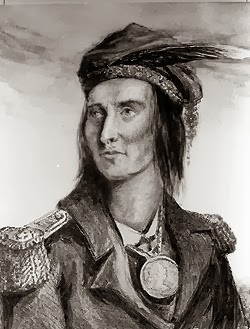
Tecumseh (“Shooting Star”) was a legendary Native American war chief of the Shawnee. His political leadership, oratory, humanitarianism, and personal bravery attracted the attention of friends and foes. He was much admired by both the British and the Americans as he led a large tribal confederacy (known as Tecumseh's Confederacy) which opposed the United States during Tecumseh's War and the War of 1812.

After his death in Ontario, Canada, at the Battle of the Thames on October 5, 1813, Tecumseh became an iconic folk hero in American, Aboriginal, and Canadian history. Details of his death in battle have been the subject of endless debate – a matter based on incomplete accounts, speculation, and popular lore.

How did Tecumseh die and what happened to his remains? Those mysteries still fascinate lovers of history.


Dramatic Rendition

The historian Allan Eckert's dramatic account is depicted in the Tecumseh! outdoor drama. In this version, the frontiersman Simon Kenton, who was at the battle and had met Tecumseh previously, was asked to identify the body after the battle. Although on different sides, Kenton and Tecumseh held a great deal of respect for each other. Kenton knew Tecumseh's body would be mutilated and scalped by the soldiers, and he felt the warrior deserved better, so he falsely identified a different body to allow Tecumseh to be taken away by his comrades at night to provide him a proper burial in a secret grave.


"Historical" Accounts

Historical accounts of Tecumseh's last day say recall that Tecumseh and 600 warriors screened the retreat of General Henry Procter and his British troop after William Henry Harrison and his militiamen had invaded Ontario in the fall of 1813.

On October 5 Harrison caught up with Procter at the Thames River near Moraviantown. The British general ignominiously fled, and after a single American volley, all his regular troops surrendered. Tecumseh meanwhile positioned his exhausted men in a patch of swampy woodland and told them he would retreat no farther.

At some point during the attack on Backmetack Marsh, Tecumseh was fatally shot. As word spread of their leader's death, one American account tells of the warriors giving, "the loudest yells I ever heard from human beings and that ended the fight."

Bill Gilbert of the Smithsonian magazine wrote …

“Having finished the British, Harrison sent dragoons and infantry into these thickets. After an hour of fierce fighting Tecumseh was killed, or presumably so. At least he was never again seen alive …

“The first battle reports – later embellished in bloody detail – claimed Harrison's brave boys had overcome 3,000 superb warriors led by the great Tecumseh. Naturally the public was eager to know which American hero had brought down this mighty Shawnee champion.

“Warriors who survived the battle told various stories. They had been forced to leave Tecumseh's body on the field. They had carried him off, either mortally wounded or dead, and buried him in a secret place that whites would never find.

“As for the Americans, none of those who first overran Tecumseh's position were acquainted with him. But they found an impressive-looking dead Indian who they were convinced was Tecumseh. Some cut strips of skin from this body, later tanning them for razor strops and leather souvenirs. When people arrived who did know him, some said the battered corpse was indeed Tecumseh's. Others said it was not. Even Harrison could not positively identify it.”

Still, a number of Americans claimed they had personally killed Tecumseh. Most prominent among them was Colonel Richard Johnson, a Kentucky politician who fought at the Thames as a cavalry commander and who said he shot Tecumseh just before he lost consciousness. Johnson never claimed to have killed Tecumseh until it became politically advantageous to do so.

Nonetheless, a great number of Johnson's constituents evidently supported his claim. With supporters chanting "Rumpsey Dumpsey, Rumpsey Dumpsey, Colonel Johnson killed Tecumseh," Johnson was first elected to the U.S. Senate and then, in 1836, to the Vice Presidency. With a little help from another catchy jingle, "Tippecanoe and Tyler Too," William Henry Harrison became President four years later.

Wyandott historian, Peter D. Clarke, offered a different explanation concerning Johnson after talking with Indians who had fought in the battle: "(A) Potawatamie brave, who, on perceiving an American officer (supposed to be Colonel Johnson) on horse … turned to tomahawk his pursuer, but was shot down by him with his pistol … The fallen Potawatamie brave was probably taken for Tecumseh by some of Harrison's infantry, and mutilated soon after the battle."

Caleb Atwater, in his History of Ohio, remarks, that two Winnebago chiefs, Four-Legs and Carymaunee, told him, that Tecumseh, at the commencement of the battle lay with his warriors in a thicket of underbrush on the left of the American army, and that they were, at no period of the battle, out of their covert – that no officer was seen between them and the American troops – that Tecumseh fell the very first fire of the Kentucky dragoons, pierced by thirty bullets, and was carried four or five miles into the thick woods and there buried by the warriors, who told the story of his fate.

After an exhaustive study, John Sugden, who provided an in-depth examination of Tecumseh's death in his book, Tecumseh's Last Stand, could not conclude that Johnson killed Tecumseh.

In another account by Clarke, "A half-Indian and half-white, named William Caldwell … overtook and passed Tecumseh, who was walking along slowly, using his rifle for a staff – when asked by Caldwell if he was wounded, he replied in English, 'I am shot' – Caldwell noticed where a rifle bullet had penetrated his breast, through his buckskin hunting coat. His body was found by his friends, where he had laid [sic] down to die, untouched, within the vicinity of the battle ground … "

Several other of Harrison's men also claimed to have killed Tecumseh; however, none of them were present when Tecumseh was mortally wounded … or, at least alive to tell about it.

Some evidence points to Colonel William Whitley as the man who killed Tecumseh. A colorful pioneer, Whitley founded modern horse racing in the United States and made some of the first Kentucky sour mash whiskey. His recipe is still used by Evan Williams and Jack Daniels. He built the first brick home west of the Allegheny mountains as well, but his fame was that of an Indian fighter.

Whitley died in the Battle of the Thames, and his body was found very close to a body claimed to be Tecumseh. In his 1929 autobiography, Single Handed, James A Drain, Sr., Whitley's grandson, gives a detailed account by Col. Whitley’s granddaughter in which Whitley and Tecumseh killed each other simultaneously.

Sugden argued that Whitley had been killed in battle prior to Tecumseh's death. But, Whitley's grandson continued to claim that his grandfather single-handedly shot and killed Tecumseh. As Drain explained it, Whitley was mortally wounded, but he saw Tecumseh spring towards him, "intent upon taking for himself a scalp", and drew his gun "to center his sights upon the red man's breast. And as he fired, he fell and the Indian as well, each gone where good fighting men go."

Still another report came from the badly-wounded Colonel James Davidson who claimed that a man in his company, Private David King, shot Tecumseh with Whitley's rifle. It was reported King was next to Whitley when he was killed, and King picked up Whitley’s rifle, which was much better than his own and was loaded and ready to be fired, and shot Tecumseh. There were also eyewitnesses who saw King take the possessions from the body of Tecumseh, which was a common act.

Edwin Seaborn, who recorded an oral history from Saugeen First Nation in the 1930s, provides another account of Tecumseh's death. Pe-wak-a-nep, who was seventy years old in 1938, describes his grandfather's eyewitness account of Tecumseh's last battle. Pe-wak-a-nep explained that Tecumseh was fighting on a bridge when his lance snapped. Tecumseh "fell after 'a long knife' was run through his shoulder from behind." The witness, who hid in the water by “turning himself into a turtle” under a log, saw Americans take the body of another warrior to a tree and mutilate it, not Tecumseh.

John Sugden wrote that the details of how Tecumseh died remain unclear. Sugdon reported Tecumseh's body was identified by British prisoners after the battle and examined by some Americans who knew him and could confirm that its injuries were consistent with earlier wounds that Tecumseh has suffered to his legs (a broken thigh and a bullet wound). The body had a fatal wound to the left breast and also showed damage to the head by a blow, possibly inflicted after his death.

According to Sugden, Tecumseh's body had been defiled, although later accounts were likely exaggerated. Sugden also discounted some conflicting Indian accounts that indicated his body had been removed from the battlefield before it could be mutilated.

From his analysis of the evidence, Sugden firmly claimed that Tecumseh's remains, mutilated beyond recognition, were left on the battlefield. Sugden's Tecumseh's Last Stand (1985) also recounted varied accounts of Tecumseh's burial and the still unknown location of his gravesite.

Absolute and perfect evidence does not exist. It is held that eight Native Americans gave testimony in relation to the death of Tecumseh. Of these, four assert that he was killed by the first fire from the American line; and four that he fell by the hands of a horseman, some time after the commencement of the action.

One of these native witnesses states that Tecumseh was shot in the neck; another, that he was hit above or in the eyes; two others that he was killed by a ball in the hip; and again two others, that he was pierced by thirty bullets on the first fire of our troops.

Three of these native witnesses testify that the body of the fallen chief was mutilated by taking the skin from off the thigh, and three that it was not.

As to the nature of his wounds, the mutilation of his body, the time when, the spot where, and by whose hands, he fell, these various statements are wholly irreconcilable with each other, and leave the main question involved in additional doubt and obscurity.

Said to be the rifle that shot Tecumseh

Burial Grounds

One of the natives who carried Tecumseh's body away from the battlefield was said to have been Oshawana (variously given as Shawnoo, Shawanaw, and Oshawahnoo) also known as Chief John Nahdee. He had been with Tecumseh in his last battle. He settled in the Township of Anderdon.

In 1848, Chief Nahdee and members of his band surrendered the 300 acres they held at Anderdon and moved to Walpole. He is said to have buried Tecumseh's bones on St. Anne Island and, when he died, passed on the knowledge of where they were. They were in the care of Chief John White when the Soldiers' Club reburied them.

No record exists of the exact location of Tecumseh’s grave. But Ken Tankersley, a University of Cincinnati archaeologist who is an enrolled member of the Piqua Shawnee and sits on the tribe’s Council of Elders, says that isn’t important. “For indigenous people, and the Shawnee in particular, what’s important is for the dead to ‘make the journey,’ or allowing the body to decompose, creating nutrients in the soil, and thus allow the cycle of life to continue.”

Tankersley notes that Shawnee will occasionally visit the battlefield and leave a tobacco offering. “We know where the battle was, and the whole battlefield is considered a sacred site, and that is close enough.” He predicts that protests would erupt if an archaeologist or anyone else ever tried to find Tecumseh’s remains. Even using noninvasive remote-sensing technology to locate the burial would be considered unacceptable, says Tankersley. “No one should ever go looking for Tecumseh.”

Of the eight native witnesses who say they saw the body, one says it was there the day after the action, lying on the battle ground; a second bears witness that it was buried on the spot the night of the battle; and a third, that it was carried four or five miles into the woods, and there interred.

There is further evidence suggesting that Tecumseh's remains may be buried on Walpole Island in Canada. Tecumseh was known to have had a broken thigh bone suffered in a fall from his horse while hunting buffalo on the Illinois prairies. Old bones were found there fitting this description. Of course, this does not prove the bones were Tecumseh's. According to an examination of the bones in the 1930s before the skeleton was reburied, the thigh bone was missing. That seems convenient, doesn't it?

The Dying Tecumseh

The Legend

A decade or so after his death Tecumseh had become “The Noble.” Towns, businesses and people were named for him. It was widely believed that his was the face that appeared on the "Indian Head" penny – a legend that overrode the facts as is often the case. No other declared enemy of the United States has been so well regarded for so long as has Tecumseh.

Praise for noble enemies – those dispatched and gone – is part of a long heroic tradition.
Whatever the accuracy of the details, Tecumseh's death remains a matter of interest and an enduring story of brave resistance. His skin was not “bullet proof.” Perhaps, his memory is.

One undeniable truth of the great leader sustains his tragic fame. Tecumseh’s single-minded mission, a secure Indian homeland, died with him in Ontario, Canada, at the Battle of the Thames. This was the demise of a truly American dream.

The Fear of Death
By Tecumseh

So live your life that the fear of death can never enter your heart. Trouble no one about their religion; respect others in their view, and demand that they respect yours. Love your life, perfect your life, beautify all things in your life. Seek to make your life long and its purpose in the service of your people. Prepare a noble death song for the day when you go over the great divide.

Always give a word or a sign of salute when meeting or passing a friend, even a stranger, when in a lonely place. Show respect to all people and grovel to none.

When you arise in the morning give thanks for the food and for the joy of living. If you see no reason for giving thanks, the fault lies only in yourself. Abuse no one and no thing, for abuse turns the wise ones to fools and robs the spirit of its vision.

When it comes your time to die, be not like those whose hearts are filled with the fear of death, so that when their time comes they weep and pray for a little more time to live their lives over again in a different way. Sing your death song and die like a hero going home.


Sources

“Autumn 1813 – Tecumseh's death launches artwork and political careers: Richard M. Johnson Campaign Slogan for Vice President.” National Park Service.

Dale K. Benington. The Death of Tecumseh Marker. July 23, 2013.

Peter Dooyentate Clarke. Origin and traditional history of the Wyandotts and sketches of other Indian tribes of North America, true traditional stories of Tecumseh and his league, in the years 1811 and 1812. 1870.

Spoon Decorah. "Narrative of Spoon Decorah. In an Interview with the Editor." Reuben Gold Thwaites, ed. Collections of the State Historical Society of Wisconsin, Vol. 13 Madison: Wisconsin Historical Society.1887.

Donald Fixico. “A Native Nations Perspective on the War of 1812.” WOSU Public Media.

Geheo. October 5, 2011.

Bill Gilbert. “The Dying Tecumseh and the Birth of a Legend.” Smithsonian Magazine. July 1995.

Charles Hamilton, ed. Cry of the Thunderbird: The American Indian's Own Story. New York: Macmillan Company. 1950.

John Sugden. Tecumseh's Last Stand. Norman: University of Oklahoma Press. 1985.

“Tecumseh, Shawnee Leader.” Archaeology. August/September 2013.

Jason Winders. "Lecture Revisits Western's Archives and Tecumseh's Death.” March 27, 2014.

Historical Note: Commentary. "Spoon Decorah" – the interview by Reuben Thwaites was conducted "at the home of Spoon, in the town of Big Flats, Adams county, some ten miles north of Friendship, March 29, 1887. Moses Paquette, of Black River Falls, acted as interpreter. Spoon, who died in a cranberry marsh northwest of Necedah, Oct. 13, 1889, was a tall, well-formed, manly-looking fellow, with a well-shaped head, pleasant, open features, and dignified demeanor ... The old man told his story in a straightforward, dignified manner, his memory being occasionally jogged by Doctor Decorah, his nephew. The Doctor is a medicine-man, held in high esteem by the Decorah, or mixed-blood element of the Wisconsin Winnebagoes, who live chiefly upon homesteads in Adams, Marquette, and Jackson counties. ... Paquette is a faithful and intelligent interpreter, and in ease carefully rendered both questions and answers. The result I have formulated into two continuous narratives, following as closely as possible the Indian manner of speech; as here printed, they meet with Paquette's approval."


Spoon 


Monday, March 3, 2014

Tecumseh -- The Legacy of "The Panther Across the Sky"


"So live your life that the fear of death can never enter your heart. Trouble no one about their religion; respect others in their view, and demand that they respect yours. Love your life, perfect your life, beautify all things in your life. Seek to make your life long and its purpose in the service of your people. Prepare a noble death song for the day when you go over the great divide.

"Always give a word or a sign of salute when meeting or passing a friend, even a stranger, when in a lonely place. Show respect to all people and grovel to none.

"When you arise in the morning give thanks for the food and for the joy of living. If you see no reason for giving thanks, the fault lies only in yourself. Abuse no one and no thing, for abuse turns the wise ones to fools and robs the spirit of its vision.

"When it comes your time to die, be not like those whose hearts are filled with the fear of death, so that when their time comes they weep and pray for a little more time to live their lives over again in a different way. Sing your death song and die like a hero going home."

--Tecumseh  "Panther Across The Sky"


When I think about the poor state of my beloved county, I often consider those in the past who also loved the ground upon which I walk. One is chief among all. Tecumseh, Native American leader of the Shawnee and a large tribal confederacy known as Tecumseh's Confederacy, was an iconic figure born on the Scioto River near my hometown.

The Shawnee believed that they were the Great Spirit's special people, and that He had given them a portion of His heart -- the Ohio Shawnee homeland. To the Shawnee, Ohio was the Garden, a sacred place to dwell.

Tecumseh opposed the United States during periods known as Tecumseh's War and the War of 1812. The Shawnee leader worked diligently to recruit additional tribes to a Native American confederacy, often traveling to the farthest reaches of land east of the Mississippi. His incredible life was testimony to his undying commitment to freedom and justice.

Throughout his childhood Tecumseh experienced many violent expansions by the colonists which would later sustain his hatred towards the United States. At least five times from 1774 to 1782, invading armies occupied tribal territory, and many times during his youth U.S militia would intersect whatever land the Shawnees were currently occupying. Tecumseh's own father took part in the French and Indian War during 1760 and later in Lord Dunmore’s War; he was killed at the Battle of Point Release in 1774.

In many cases the Americans would set two tribes against one another through treaties with one party representing the land of the other. Tecumseh never believed in signing such treaties. He wanted the tribes to follow their native beliefs about their lands.

For example, during the Treaty of Fort Stanwix, the Iroquois tribe claimed ownership to all of Ohio lands therefore they deemed it acceptable to sell the Shawnee territory to America in exchange for money. 

As the United States greedily claimed Native American acreage, they plundered many native villages. The invading imperialists created many conflicts including a battle that led to the death of Tecumseh's father Puckeshinwa. It is said that Puckeshinwa's death was cold-blooded murder by white frontiersmen who had crossed onto Indian land in violation of a recent treaty, and that Tecumseh and his mother found him dying.

As he watched his father die, Tecumseh vowed to become like "a fire spreading over the hill and valley, consuming the race of dark souls." A few years later, Tecumseh's hatred for the whites was compounded by the murder of Cornstalk, a Shawnee chief who had been a mentor to the young man.

At the young age of 15, Tecumseh joined a band of Shawnee, including his older brother Cheeseekau, who were determined to stop the white invasion of their lands by attacking settlers' flatboats traveling down the Ohio River from Pennsylvania.

For a while, these Indian raids were so effective that river traffic virtually ceased. But, in truth, with a population estimates of only 1000, the Shawnee alone had little hope of resisting the onslaught of land-hungry settlers and the U.S. military.

Cheeseekau and Tecumseh eventually joined and fought alongside the Chickamauga faction of the Cherokee. During a series of raids against frontier settlements in Kentucky and Tennessee in the late 1780s and early 1790s, Cheeseekau was killed, and Tecumseh assumed leadership of the small Shawnee band, and subsequent Chickamauga raiding parties.Tecumseh returned to Ohio in late 1790.

More and more Native Americans rejected the notion that the British or Americans could dispose of their tribal lands without their consent. They formed the Western Confederacy, an alliance of Native American nations, to fight to retain their traditional lands. Elements of tribes such as the Council of Three Fires, Shawnee,  Iroquois, Wabash, Wyandot, and the particularly strong Miami joined the confederacy.


It achieved several victories over United States military forces in 1790 and 1791, alarming the administration of President George Washington. Washington ordered Revolutionary War hero General "Mad" Anthony Wayne  to build and lead a new army to crush resistance to American settlement.

The American government thus fought a war over the possession of the Ohio area Indian land. The Battle of Fallen Timbers (August 20, 1794) was the final battle of the so-called Northwest Indian War, a struggle between Native American tribes affiliated with the Western Confederacy against the United States for control of the Northwest Territory.

At Fallen Timbers, the First Nations tribal alliance was heavily outnumbered and outmaneuvered by the U.S military. In the battle, Blue Jacket was defeated soundly by Wayne after which Wayne's army spent several days destroying the native villages and crops in the area.

The defeat of the natives led to the signing of the Treaty of Greenville in 1795, which ceded much of present-day Ohio to the United States. Tecumseh, a young Shawnee veteran of Fallen Timbers did not sign the Greenville Treaty.

So it was that the first Pan-Indian Movement (in which organizations sought to pool the resources of indigenous groups in order to protect the interests of native peoples) came to an end. Behind a line of forts, white settlers moved into the Ohio country, leading to the admission of the state of Ohio in 1803.

Despite overwhelming odds, Tecumseh never gave up the fight for his homeland. During the battle Tecumseh led an offensive attack that led to a temporary U.S. retreat and the release of American battle animals, mainly horses. Due to his spirited determination during the battle over 250 men followed him after the dissipation of the alliance to a small territory where they would organize their own settlement with Tecumseh as their chief. However, the United States continued their onslaught of Native American villages forcing Tecumseh and his tribal people to relocate continuously thus threatening their maintenance of life.

Tecumseh and his small band moved in the spring of 1798 to the west fork of the White River, Indiana. At the turn of the century, there were fears for their livelihood, for land, for culture and, most terrifying, for their survival in the face of epidemic diseases to which the people had no immunity.

Tecumseh's brother, Lalawethica, renewed support for a tribal alliance based on the belief that all Native American territory was universal for every Native American community. Lalawethica, later known as the Prophet and Tenskwatawa, experienced a dream that led him to preach this allied system which developed into a religious value.

Invigorated by the dream, Tecumseh began to promote these ideas as well, continually fighting off U.S. explorers and gathering Native Americans of all tribes. Tecumseh eventually emerged as the leader of the confederation built upon a foundation established by the religious appeal of his younger brother. It gathered converts from the Shawnee, Canadian Iroquois, Chickamauga, Meskwaki, Miami, Mindo, Ojibwe, Ottawa, Kickapoo, Delaware, Mascouten, Potawatomi, Sauk, and Wyandot.

Following another yet another expulsion from their land, Tecumseh and his tribe relocated near Tippecanoe and developed an impressive community nicknamed Prophetstown by Americans.  Thousands of Algonquin-speaking Indians gathered there to gain spiritual strength. 

Soon, the Shawnee understood the importance of tribal alliance in coalition with the British to repel the United States away from Native American territory. Tecumseh traveled to Canada to organize an agreement between tribes and the British. He was deeply distrustful of the British, but his efforts greatly raised his standing among the tribes of the First Nations.

With the clarity provided by hindsight, many scholars believe the redcoats wanted to secure favor among the First Nations but did not want to be seen by the Americans as inciting them.

Tecumseh developed into a fiery orator with a clear message: the First Nations must stand together to save their land and cultures; however, he found organizing First Nations resistance efforts very difficult. The tribes were deeply divided by language and outlook. Central to the combined resistance was the idea that the land belonged to all Aboriginal people and that past and future negotiations with individual tribes were invalid.

Tecumseh's task of building an Aboriginal confederacy was enormous given the forbidding geographical distances, the sense of powerlessness of many of the tribes, the jealousy of the older chiefs, tribal rivalries, and communication in different languages. Even the different Algonquian groups could not understand one another without interpreters. 

Even his enemy, William Henry Harrison respected Tecumseh as more than a great warrion. Harison wrote a tribute in 1811:

"The implicit obedience and respect which the followers of Tecumseh pay to him is really astonishing, and more than any other circumstance bespeaks him one of those uncommon geniuses which spring up occasionally to produce revolutions and overturn the established order of things."
 
Yet, while Tecumseh traveled preaching for tribal alliance among different Native American societies, the Indiana Governor, William Henry Harrison, signed the Treaty of Fort Wayne that allotted him a mass amount of Native American territory.

Governor Harrison also discovered that Tecumseh was requesting weapons and war supplies. In talks filled with mounting tension, Harrison met Tecumseh at Vincennes in July 1811. There, it is believed Tecumseh erred by telling Harrison that he would be on a long trip to the South and absent from Prophetstown until spring. Harrison rejected Tecumseh's claim that all the Indians formed one nation.

As tensions rose at the meeting, Harrison openly denounced Tenskwatawa as a fraud and a fool, enraging him. Tecumseh ordered his brother to take no action, but Tenskwatawa continued to call for the death of Harrison. Before leaving, Tecumseh informed Harrison that unless the treaty was nullified, he would seek an alliance with the British. 

Tenskwatawa went back to Prophetstown where he was to wait for Tecumseh's return and not engage the enemy. Yet, Tenskwatawa took his brother's absence as an opportunity to raise tensions even higher by further stirring up his followers.

Harrison received the authorization to march against the confederacy in a show of force, hoping that they would accept peace. Soon, Harrison moved a large force near Prophetstown at the confluence of the Tippecanoe and Wabash Rivers.

As fate would have it, the Prophet was unable to restrain his warriors and sniping between sentries escalated into a full-scale battle. Tenskwatawa, perhaps suspecting that Harrison intended to attack the village, decided to risk a preemptive strike, sending out about 500 of his warriors against the American encampment. The result was disastrous for the natives.

The warriors held their own but were forced to withdraw when they ran out of ammunition. They quickly retreated to Prophetstown where, according to one chief's account, the warriors confronted Tenskwatawa and accused him of deceit because of the many deaths, which his spells were supposed to have prevented. He blamed his wife for desecrating his magic medicine and offered to cast a new spell and insisted that warriors launch a second attack, but they refused. Then, Harrison followed the retreat and entered Prophetstown, finding it deserted except for one elderly woman too old to flee.

Harrison ordered his troops to spare the woman, but to burn down Prophetstown and destroy the Native Americans' cooking implements, without which the confederacy would be hard pressed to survive the winter. Everything of value was confiscated, including 5,000 bushels of corn and beans. beans.Some of Harrison's soldiers dug up bodies from the graveyard in Prophetstown to scalp.


William Henry Harrison was hailed as a national hero and the battle became famous. However, his troops had greatly outnumbered the attackers, and suffered many more casualties during the battle.

Tecumseh was furious with his brother for falling for Harrison's trap and threatened to kill him. It was a devastating blow to the confederacy. However, although it was a significant setback, Tecumseh began to secretly rebuild the alliance upon his return from the south. Frontier violence actually increased after the battle.

Tecumseh still refused to adhere to treaties he had not signed and believed it his duty to keep fighting those who occupied his land. Prophetstown was partially rebuilt over the next year, though it was again destroyed by a second campaign in 1812. Tecumseh's confederacy was ready to launch its own war against the United States, this time with British allies.

When the United States declared war on Great Britain on June 18, 1812, Tecumseh and the group of about 350 warriors from various tribes traveled to Canada to organize militant strategies.

Tecumseh and his men were assigned to overtake the city of Detroit with Major General Isaac Brock. The taking of the city was a major success as the Americans surrendered due to fear of the unknown numbers of Native Americans there attacking. Tecumseh, who led the First Nations into this battle, was regarded as a hero among the tribes, Canada, and Britain.

Then, the First Nations were utilized in defending Detroit, blocking off American supply lines, and preserving areas in Northwest Canada. The British, in effect, selfishly used the First Nations to secure Canada for themselves, caring little about helping the natives regain their Ohio homeland.

The British position depended on maintaining command of Lake Erie. The sparsely populated region produced insufficient crops and cattle to feed British troops, the sailors of the British ships on the Lake, and above all, the large numbers of Native warriors.

On September 10, Perry gained a complete victory in the Battle of Lake Erie, after a hard-fought battle. On receiving Perry's hastily written note that "We have met the enemy and they are ours," Commander William Henry Harrison knew that British Major General Procter would be forced to retreat, and ordered an advance. One thousand mounted troops began advancing along the lake shore to Detroit, and 2,500 foot soldiers were carried there and to Amherstburg by Perry's ships once the damage they had received in the battle had been repaired.

Even before Perry's victory, Procter had made preparations to fall back to the British position at Burlington Heights at the western end of Lake Ontario. Tecumseh and his warriors faced certain death unless they retreated. Tecumseh also knew that this would remove all protection from the tribes in the confederation whose lands lay to the west of Detroit and had attempted to dissuade Procter, saying:

"Our fleet has gone out, we know they have fought; we have heard the great guns but know nothing of what has happened to our Father with one Arm (Barclay, who had lost an arm in 1809). Our ships have gone one way, and we are much astonished to see our Father [Procter] tying up everything and preparing to run the other, without letting his red children know what his intentions are ... We must compare our Father's conduct to [that of] a fat animal that carries its tail upon its back; but when affrighted, it drops it between its legs and runs off."

Harrison pursued Procter on October 2, and his men captured several abandoned boats and a steady stream of British stragglers. They caught up with the retreating British and Indians late on October 4

William Henry Harrison's force numbered at least 3,500 infantry and cavalry. Procter had about 800 soldiers. Tecumseh led a group of around 500 native warriors.

The British soldiers were becoming increasingly demoralized, and Tecumseh's warriors grew ever more impatient with Procter for his unwillingness to stop and fight.Tecumseh skirmished with the Americans near Chatham to slow the American advance, but the warriors were quickly overwhelmed. The batteaux carrying reserve ammunition and the last of the food went aground and were left behind, to be captured by an American raiding party.


The Battle of the Thames

The night before the end, Tecumseh told First Nation leaders who had gathered: "Brother warriors, we are about to enter into an engagement from which I shall never return. My body will remain on the field of battle." He then gave a sword the British had given him to another Indian and said, "When my son becomes a noted warrior, give him this." 

It is said when the great warrior went into battle the next day, Tecumseh wore buckskin, ostrich feathers on his head and a medal around his neck. 

Shortly after daybreak on October 5, after ordering his troops to abandon their half-cooked breakfast and retreat a further two miles, Procter formed the British regulars in line of battle with a single 6-pounder cannon. He planned to trap Harrison on the banks of the Thames, driving the Americans off the road with cannon fire. However, he had taken no steps towards fortifying the position (e.g. by creating spiked wooden defences or throwing up earthworks), so the ground presented no obstacle to the American mounted troops, while scattered trees masked the British fire.

Tecumseh's warriors took up positions in a black ash swamp on the British right to flank the Americans. Tecumseh rode along the British line, shaking hands with each officer, before joining his warriors.

Richard Johnson charged into the Indian position at the head of about 20 horsemen to draw attention away from the main American force, but Tecumseh and his warriors answered with a volley of musket fire that stopped the cavalry charge. Fifteen of Johnson's men were killed or wounded, and Johnson, himself, was hit five times.

General Harrison surveyed the battlefield and ordered James Johnson (brother of Richard Mentor Johnson) to make a frontal attack against the British regulars with his mounted Kentucky riflemen. Despite the Indians' flanking fire, Johnson broke through, the British cannon having failed to fire. The exhausted, dispirited and half-starved British troops fired one ragged fusillade before giving way. Immediately Procter and about 250 of his men fled from the field. The rest surrendered.

Tecumseh and his followers remained and carried on fighting. Richard Johnson charged into the Indian position at the head of about 20 horsemen to draw attention away from the main American force, but Tecumseh and his warriors answered with a volley of musket fire that stopped the cavalry charge. Fifteen of Johnson's men were killed or wounded, and Johnson was hit five times. General Harrison’s infantry could not dislodge the natives from the swamp

Johnson's main force became bogged down in the swamp mud.  The battle raged on for quite a long time. It is believed that Tecumseh was killed in the afternoon of October 5, 1813. His shocked warriors lifted his body and fled into the woods. It is said that the warriors buried Tecumseh, then age 45, in some unknown location.

The main force finally made its way through the swamp, and James Johnson's troops were freed from their attack on the British. With the American reinforcements converging and news of the death of Tecumseh spreading quickly, native resistance quickly dissolved.

* As a sidenote: At least 24 people took credit for pulling the trigger that killed Tecumseh. Harrison, who served as the ninth U.S. president, built his reputation as “vanquisher of Tecumseh.”  Richard Mentor Johnson also claimed to have killed the Shawnee chief. Richard Mentor Johnson eventually became Vice President to President Martin Van Buren, based partly on the belief that he had vanquished the great warrior. As Martin Van Buren's running mate, Johnson's campaign slogan was: "Rumpsey Dumpsey, Rumpsey Dumpsey, Colonel Johnson killed Tecumseh."

* Another of the grisly legends that grew out of that battle was the skinning of Tecumseh. For years afterward, Kentucky veterans of the battle would show their friends strips of leather they claimed were made from the hide sliced from the recumbent form of Tecumseh himself. 

* Some of Tecumseh's braves later told a different story. His face stained with blood from a head wound, Tecumseh shouted encouragement to his warriors until he was mortally wounded by a bullet in his left breast. A few followers then carried him from the field and secretly buried him. His body was never recovered, at least not by white men.

In May 1814, Procter was charged with negligence and improper conduct. The court martial judged that Procter had managed the retreat badly, failing to secure his stores, and also disposed the troops ineffectively at Moraviantown. He was sentenced to be suspended from rank and pay for six months.


Legacy

Tecumseh is arguably the greatest leader his culture has ever produced. Many noted his vision, honor and eloquence. He repeatedly proved himself to be brave, charismatic, fearless and fair. On the battlefield he was fierce and disdained cowardice. Adamantly, he insisted that prisoners be treated humanely.

Tecumseh represented the uncompromising Native American struggle against U.S. expansion, and although he never personally experienced victory, he influenced many future tribes to continue their resistance. It is easy to see the heart of the man: He simply wanted to life in happiness and freedom on his ancestral lands.

Perhaps the most amazing thing about Tecumseh-- his life, character, accomplishment, and, yes, even his failure -- is that nothing in the life of this Native American martyr is either fictionalized or exaggerated. The truth defies fiction: This man lived an entire life fighting, leading, and negotiating to secure his beloved homeland despite scant support for his Pan Indian movement. Against staggering numbers of interlopers, Tecumseh represented hope to all Native Americans, and he lived up to his given name like a meteoric shooting star, the Panther across the dark sky. No other person symbolized the tragedy, mistreatment, and organized calamity that befell his native people.

That calamity is the genocide of the natives by largely European immigrants who believed in settling in new homelands, pushing out the old inhabitants, and claiming ownership of the very real estate created by Mother Nature and the Great Spirit. With Finnish, Scotch-Irish, and English roots, I am a part of this terrible injustice. I must bear this, yet I fear I do not do enough to protect this land I love. The biography of Tecumseh reminds me of a man who never compromised his mission to live here and to proper here.

Sometimes I look at my beautiful Scioto homeland in its present state of human indifference and decline, and I wish I were born hundreds of years before in a Shawnee village where I would have been taught proper respect and care for my surroundings. The land upon which we live is alive not only with its natural beauty but also with its bittersweet history. I believe it is our sacred duty to teach our children well. We must re-instill appreciation and confidence that we can be better stewards of our home ... a land we occupy for awhile and never truly own, as we dwell on its sacred ground.

"Brother, I was glad to hear what you told us. you said that if we could prove that the land was sold by people who had no right to sell it, you would restore it. I will prove that those who did sell did not own it. Did they have a deed? A title? No! You say those prove someone owns land. Those chiefs only spoke a claim, and so you pretended to believe their claim, only because you wanted the land. But the many tribes with me will not agree with those claims. They have never had a title to sell, and we agree this proves you could not buy it from them."

--Tecumseh