Thursday, December 19, 2019

Beatlemania -- Sugar and Spice Hysteria


As a young man anxiously seeking the next Beatles release, I distinctly remember hovering over my transistor radio in 1963 and painstakingly tuning in WLS, the Chicago radio station whose tremendous nighttime signal reached masses of fans in over 38 states.

WLS DJ Dick Biondi was the first to play "Please Please Me" in February. I was hooked. These early Beatles recordings changed my life. I was twelve years-old at the time – impressionable and searching for something. (What? I had no clue.) It was then I first began to “rock,” and immediately I began a lifelong musical journey I would never abandon. But, let me tell you about my female classmates and their insatiable obsession with the band.

Beatlemania!

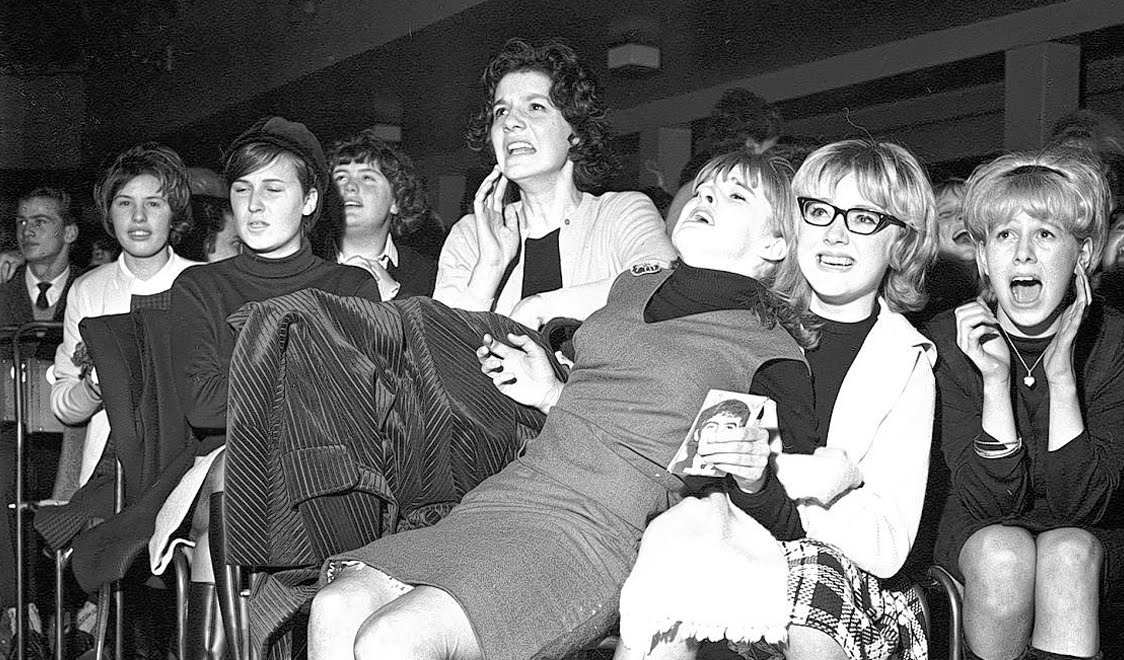
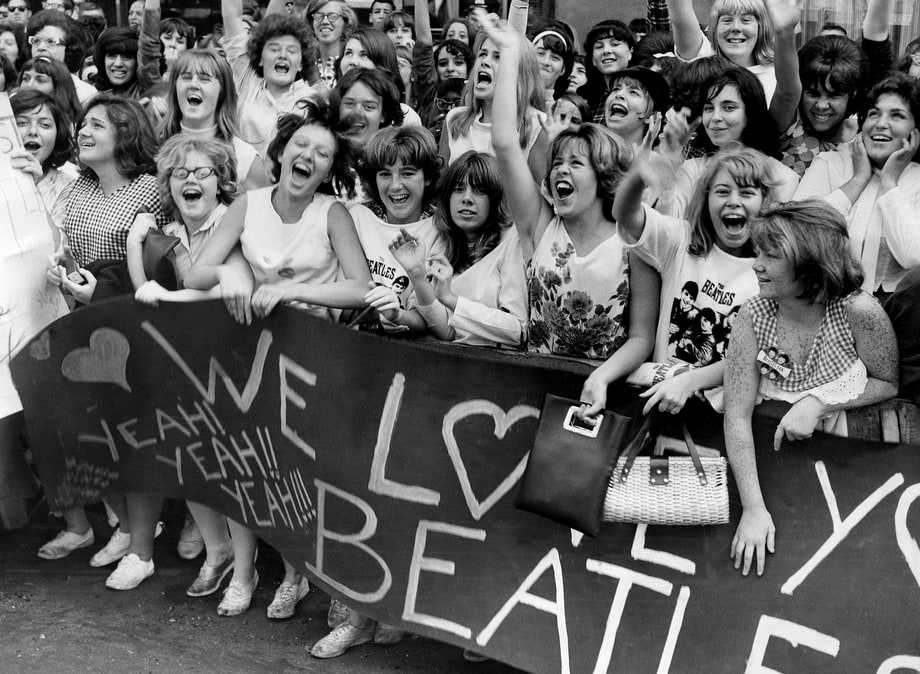
How I remember the unprecedented adulation of the Beatles. All we young people felt the incredible excitement of the times and the impact of their music; however, the mass hysteria for the Fab Four exhibited by girls – their manic, their uncontrollable and frenzied fixation – exemplified this unique cultural phenomena. Girls simply loved the Beatles and everything about them – they were truly “hysterical” in their idol worship of the group. John Lennon, Paul McCartney, George Harrison and Ringo Starr enraptured the very souls of those teenyboppers.

“We love you, Beatles
Oh, yes, we do
We love you, Beatles
And we'll be true”

– popular song by the Carefrees


The word “hysteria” describes involuntary conversion of psychological stress, or specific frustrated impulses, into symbolic symptoms or behavior. The frenzied hysteria of Beatlemania-bitten girls – screaming, fainting, wild paroxysms – was akin to an involuntary orgasmic reaction or wave of collective hypnotism.

“I didn't understand why you had to scream and I didn't have an impulse to scream but it was what you did. It was mandatory. There was this cult-like element to it.”

– Linda Grant, English novelist and journalist

By the time the Beatles hit their stride, the first wave of post-World War II baby boomers were reaching their teens. It a time of unprecedented economic prosperity in the West, and for many listeners, the Beatles’ joyous and optimistic music seemed as suited to the era as a soundtrack. The boomers were preparing to enter the Age of Aquarius: peace, love, and understanding. Along came the Beatles. The British Invasion swept America like a tsunami.

At Beatles concerts and public appearances, battalions of policemen herded fans behind fences and barricades. The screams and cries of young ladies was deafening. Journalists compared the sounds made at Beatles’ concerts to the nerve-shredding cries of pigs being brought to slaughter.

When the Beatles played Shea Stadium in 1965, The New York Times reported that the crowd’s “immature lungs produced a sound so staggering, so massive, so shrill and sustained that it crossed the line from enthusiasm into hysteria and soon it was in the area of the classic Greek meaning of the word pandemonium – the region of the demons.”

"Teenage girls were perceived as a mindless horde: one huge, undifferentiated emerging hormone."

– Linda Grant

Of course, the great talent and fortuitous timing of the Beatles was solidified by the fact they acted and behaved as a tightly-knit group. Previously, in both England and America, most successful pop and rock acts emphasized individuals: solo performers like Elvis Presley, Buddy Holly, and Bill Haley, all of whom fronted a band. The Beatles were the first iconic rock band, and they came in a time of togetherness.

John McMillian of The Daily Beast wrote this of the band:

“The Beatles, on the other hand, were an indivisible group in which each member nevertheless had distinctive attributes: John was typecast as the clever, intellectual one; Paul, the romantic charmer; George, quiet and mysterious; and Ringo, the easygoing goof.”

Teens loved the group as a whole and as individuals. Doting teenyboppers found the fellows irresistible. The lads from Liverpool were the “coolest,” the “grooviest,” the “most far out,” and simply “gear.” 60s culture began and ended with Beatlemania.

And, oh my, did those young girls express their unashamed desire for “everything Beatles.” Then teenage girls were still expected to be paragons of purity – quiet and passive, perfectly well-behaved ladies. The fashionable Beatlemaniacs ushered in a revolution to protest the sexual repressiveness and the rigid double standard of female teen culture. 


In 1977, a trio of scholars – Barbara Ehrenreich, Elizabeth Hess, and Gloria Jacobs – observed an rudimentary element of protest in Beatlemania. Their argument (professed in the essay “Beatlemania: A Sexually Defiant Subculture?”) went like this …

“Society was becoming increasingly sexualized in the ’50s, yet girls were always asked to walk a delicate line. They were advised to make themselves appealing to boys and to get dates, but also to remain pure and chaste. To those ends, girls were expected to police their own ranks; a young teenager who was too sexually forthcoming risked being ostracized by her peers. In that context, “to abandon control – to scream, faint, and dash about in mobs – was, in form, if not conscious intent, to protest the sexual repressiveness, and rigid double standard, of female teen culture.”

In addition, some scholars argued that the Beatles' famous moptop haircuts signaled androgyny and thus presented a less threatening version of male sexuality to teenage girls. Maybe it was just that girls thought the Beatles with their revolutionary longer hair were so darned cute. All I know is that every testosterone-filled young male was soon engaged with his parents in a battle to grow long Beatle locks.

By 1963, the Beatle haircut was firmly established as an easily-recognizable part of the Beatles joint persona. CBS report Bill Crandall put it nicely …

“Their trademark moptops not only made possible the Ramones' bowl cuts, Justin Bieber's combover and an entire decade of hair metal, but it gave the Sixties its most iconic image: long hair. Thanks to the Beatles, follicle freedom soon flowed from the ports of Liverpool to the parks of San Francisco to the lights of Broadway in the form of a smash musical, naturally entitled Hair.”
Of those sexually repressed female Beatles fans, McMillian asserts …

“These young girls were not yet ready for the women’s liberation movement, the argument goes, but they were willing to trespass on propriety by asserting 'something' (it’s hard to say precisely what) about their sexuality, or their innermost desires, in a public and ritualized fashion. So Beatlemania was not just rebellious but also 'in its own unformulated, dizzy way, revolutionary.'”

Young people in the 60s were looking for community and identity. The Beatles supplied that and much more – charisma, taste, and sexuality, They endeared themselves to the public, and while mocking the media and their own celebrity status, the group won the undying devotion of their teenage fans. One female fan wrote of her Beatlemania …

"People think they're silly but they're not. It's the togetherness. We had this big communal thing that we all knew and loved and understood — something that was yours and nothing to do with your mum and dad. We were all in it together. It was lovely."

Thus, the Beatles were icons of the rebellious counter-culture of the 60s. The fathers and elder brothers of Beatles fans scorned what they saw as their unmanly appearance and music, but that made their appeal even stronger, particularly after the Beatles took a darker and more psychedelic path later in the decade.

So, as part of all of that frenzy and hysteria, the swooning masses of Beatlemaniac females helped change the culture of the world. During the span of their recording years between 1962-1970, the Beatles transcended popular music while leaving a lasting legacy that signaled significant youth-driven changes in post-World War II society.

As pop stars bigger than Sinatra or Elvis before them, the Beatles captured the hearts and minds of youth. Music, art, politics, fashion, sexual morality – the socio-cultural impact of the band transcended Beatlemania and the religion of teenage culture. They remain the most influential band of all time.

And, by the way, those young ladies who were so widely overtaken in the overwhelming "involuntary conversion" many decades ago can still testify to the legitimacy of the hysteria. I feel confident that their old scrapbooks, magazines, recordings, and memorabilia forever occupy sacred places in their memories, if not as articles of their lasting possessions. 

Tuesday, December 17, 2019

Why Does God Allow Child Abuse?


We were spending a pleasant evening at home with friends. As we talked about current events and other pertinent topics, one person shared a hideous online video depicting a particularly brutal case of child abuse. We were all shocked and outraged by the criminal behavior.

After viewing the abuse, my wife was so upset that she posed the age-old question: “How are we to explain how an eternal, all-knowing God allows painful suffering and death to happen to innocent little children, not only now but throughout recorded human history?”

The rest of us were lost for words to adequately explain the answer. Some of us uttered some ill-conceived explanation while merely shaking our heads in frustration and disbelief. 

This is a question that we all ask ourselves. Is there an answer?

I decided to search for a plausible explanation.

Pope Francis once said …

"Look at the Child of God on a cross. I don't know what other answer to give you. But let's talk about why God allows it, which is the core of the question. Quite simply, because he created us as persons, and as such: free. God is respectful of freedom. He allowed his son to be killed on the cross. The game of human freedom: God risked a lot here. It would more dishonor man, if God could take away his freedom, than if man, with his freedom, committed a crime.”

The Bible tells us that since the beginning of human experience God has given humans freedom of choice freedom to act rightly, act wrongly, or not act at all. The Bible is emphatic on its teaching that humans possess free will and are capable of originating evil. Because love must be freely chosen, God cannot simply decree that he will get what he wants. He pleads with people to turn to him, but he will not coerce them.

From the Beginning

In the garden of Eden, God created the first humans in his very own image. That is, he imparted mind power to our first parents – the ability to think, plan, reason and create, and, most important, the ability to exercise decision making powers.

Scriptures tell us the first two humans were given a choice. Since God gave Adam and Eve a choice, God is in charge. He is therefore responsible for whatever happens. But if the first humans chose freely to go the wrong way, the fault is theirs and the penalties theirs and their children's. Instead of choosing to obey God's government over their lives and do things God's way, they chose to do things their way.

God advised them to take of the "tree of life” which symbolized outgoing concern for others, God's way of doing things, obedience to his authority, and acceptance of his revealed knowledge. God warned them against choosing the opposite way, portrayed by the "tree of the knowledge of good and evil" — representing selfishness, reasoning apart from God, acquiring knowledge by trial and error, even living life in outright rejection of God's revealed way of outgoing concern for others

“And the Lord God commanded the man, 'You are free to eat from any tree in the garden; but you must not eat from the tree of the knowledge of good and evil, for when you eat from it you will certainly die.'"

(Gen. 2:16-17)

Adam and Eve chose badly. Eve was deceived by Satan. Adam willingly – not willfully – chose to go the wrong way. They rejected God's way and chose Satan's way instead. They rejected God having any authority in their lives. They built their own society and civilization cut off from God's revelation, from his revealed spiritual and physical knowledge. Christians would later say that is how this world became Satan's world

Thus, the Scriptures tell us that suffering came into the world as a consequence of the fall of man and of creation; that is to say, it is because of sin that God has visited judgment upon this planet. That judgment includes the curses of pain, disease, sorrow, and death that attend the consequences of wickedness. We must recognize that we truly live in a fallen world. This means bad things can happen to good people, and good things can happen to bad people.

What about children? Surely young, innocent children are not responsible for their own hardships. Virtually every church in Christendom has had to develop some concept of “original sin” because the Scriptures teach us so clearly that we are born in a sinful state and that the curse of the fall attends every human life.

How difficult it is to accept that monstrous child abusers have the same free will as good people. The reality that people are free to violate the free will of less powerful people isn’t a sign that God is weak or morally corrupt. Instead, it’s a sign of just how sacrosanct God considers human free will.

That sounds grim and dreadful until we realize that in that judgment on fallen humanity comes also the tempering of God’s wrath with mercy and grace and His whole work of redemption. Christians believe in a special measure of grace that God has reserved for those who die in infancy. Jesus said …

“Suffer the little children to come unto me, for to such belongs the kingdom of God.”
(Matt. 19:14)

The understanding is clear: “Death does not rule.” In his resurrection, Jesus Christ overcame sin, Satan, and death. For Christians, death is not the end but a transformation to a fuller life in Christ. Through the grace and righteous judgment of God, the innocent and the sinners find eternal justice.

What about God eventually assuming the responsibility for giving humans choice? Christians believe He will intervene in human affairs by sending Jesus the Messiah the second time to put an end to suffering and ignorance by deposing Satan and restoring the government of God.

"And I heard a loud voice from heaven saying, 'Behold, the tabernacle of God is with men, and He will dwell with them, and they shall be His people, and God Himself will be with them and be their God. And God will wipe away every tear from their eyes; there shall be no more death, nor sorrow, nor crying; and there shall be no more pain, for the former things have passed away'"

(Rev. 21:3-4)

In the meantime, the laws of nature function and human free-will is operative. This does not mean that God can never intervene, simply that when God does intervene, there will be consequences. He cannot intervene all the time: this would undermine the point of free will.

And, in the meantime, God can save children, or adults, from disease, death or injury in accidents. God can intervene and God does intervene to help and protect many of those choosing to live life His way.

Austin Farrer (1904–1968) – English Anglican philosopher, theologian, and biblical scholar – created a concept called “double agency.” Double agency is a concept which suggests that both God and a human being can cause an event because the nature of God’s action is to work in and through other agents.

Farrer writes: “God’s agency must actually be such as to work omnipotently on, in, or through creaturely agencies without either forcing them or competing with them.” The agency of God and creatures must be understood as being on two different levels.

In one event both the divine and creaturely agents are fully active. God has not overwhelmed the finite agent so that it is merely a passive instrument, and God is not simply the creator and sustainer who allows the creaturely agent to act independently of divine agency. Furthermore, the divine and finite agents are not merely complementary, that is, they do not contribute distinct parts to the one event. As many authors have put it, God acts in and through the finite agent which also acts in the event.

If God doesn't allow any suffering, not only do we humans lose our free will, but if all suffering is eliminated, we also fail to learn from our painful experiences. After all, most pain is not in vain. Trials and suffering make us spiritually stronger.

Grace means "unmerited favor.” In 2 Corinthians 12, the Apostle Paul speaks of a "thorn" in his flesh. Three times he begged God to remove it. Three times God denied him. God's answer:

"My grace is sufficient for you, for my power is made perfect in weakness."

(2 Corinthians 12:9)

So, why does God let the righteous suffer?

It gives absolute proof where their true loyalty is. It allows those so tested to build godly character that will last for all eternity – character that continues on into eternal life when Christ returns to restore the government of God on earth and to reward individuals who serve him.

"And, behold," says Jesus, "I come quickly; and my reward is with me, to give every man according as his work shall be.... Blessed are they that do his commandments, that they may have right to the tree of life... "

(Rev. 22:12, 14)

The final consequence of God intervening to prevent all child suffering would mean His existence would never be in doubt. If anyone said “I don’t believe in God” then all that would be required would be for me to put a child in danger and watch as the child is miraculously saved. However, if God wants His existence to be less than obvious, that is, if He wants people to come to Him through faith and love not through compulsion, then He cannot act in this way. His interventions have to be less regular to allow people to deny His existence, if they choose to.

We can only choose God if we have free will. For Him to unilaterally stop sex abuse of children would require Him to overrule the free will of men. We are here on this planet for the sole purpose of preparing for Eternity. Jesus is the Gateway to Eternity with God, rejecting Him means Eternity without God.


Personal Beliefs

In closing, I believe God does not “allow” children to be abused. Sick, evil humans choose to defy God and abuse children. No scripture condones such wicked behavior.

“And he said, That which cometh out of the man, that defileth the man. For from within, out of the heart of men, proceed evil thoughts, adulteries, fornications, murders,thefts, covetousness, wickedness, deceit, lasciviousness, an evil eye, blasphemy, pride, foolishness: All these evil things come from within, and defile the man.”
(Mark 7:20-23 King James Version)

Why must innocent children suffer? Tying the reason to the original sin makes some kind of sense of it. Yet, other times it feels totally meaningless and causes us to question everything we consider holy. After all, we all are only humans with limited understanding.

Perhaps, God's elaborate plan is simply beyond our simple comprehension. Does God plan to restore men to their pre-fall condition while the devil (with the willing help of millions of misguided humans) keeps disrupting God’s progress? The prophecy of Judgment Day remains intact.

Until then, the evil of human beings rages. Innocent children – those innocents most undeserving – suffer for no reason other than the depravity of man.

The “Nothingness” Presence of Evil

“There is in world-occurrence an element, indeed an entire sinister system of elements, which is not…preserved, accompanied, nor ruled by the almighty action of God like creaturely occurrence.”

– Karl Barth

Karl Barth, a Swiss Reformed theologian, is probably the best representative of a school of thought that says evil must be understood as both not something and not nothing. Accordingly, he refers to evil as “nothingness” (das Nichtige in German). He goes on to describe evil as a force that threatens to corrupt and destroy God’s good creation.

To Barth, evil can only be categorized (if at all) as an “alien factor” in the world which seeks to corrupt and undo the creation, to drag the world back into the pure nothing from which God created. For Barth, God willed and created for a good purpose of election, but das Nichtige can only be seen as that which God did not will or did not elect at all. Das Nichtige stands in opposition to both nature and grace, and thus is entirely unnatural and anti-grace.

Barth is thus proclaiming that to think biblically about evil, we must understand that because it exists in a way that is wholly in contradiction to God’s eternal, set will, and because it has been decisively conquered by Jesus, it is correctly understood only as “nothingness.”

Barth is not playing word-games here – he’s saying that evil is almost nothing and can only lead to being absolutely nothing. To make his point, he must stretch human language to its limits. In doing so, he helps us understand evil, in the light of Christ, for what it actually is – “nothingness” (that which is next to nothing). The doctrine of das Nichtige absolutely refuses any notion that evil properly belongs to the will of God, whereas most Reformed thinkers have affirmed that God intentionally decrees every last occurrence, evil or otherwise.

“Sin is not confined to the evil things we do. It is the evil within us,
the evil which we are.”

– Karl Barth

Wednesday, November 27, 2019

Donald Trump -- Ordained and Chosen?


“ Mr. President … you said you were the chosen one. You were … You are here in this time because God ordained you.’”

– Rick Perry

People like Former Secretary of Energy Rick Perry and conservative commentator Wayne Allyn Root believe Donald Trump is the “Chosen One,” relating his presidency to the second coming of God.

"The King of Israel? The second coming of God? He thinks he's Jesus. That's where we are," tweeted Diana Butler Bass, a scholar specializing in American religion and culture.

Trump has actually referred to himself as the “Chosen One,” and though many doubt he has a Messiah complex, (Trump later tweeted he was "kidding" and "being sarcastic" when he called himself the "chosen one.”), the belief that Trump was specifically chosen by God to occupy the office is prevalent among evangelicals.

Perry puts it like this:

 "God's used imperfect people all through history. King David wasn't perfect. Saul wasn't perfect. Solomon wasn't perfect … If you're a believing Christian, you understand God's plan for the people who rule and judge over us on this planet in our government.”

John Fea, professor of American history at Messiah College, explains that the phrase “Chosen One” is probably part Christianity, part science fiction, part myth, part fantasy, part Harry Potter." Fea said. "But at the same time, there is embedded within that phrase this idea that God chooses certain people — and evangelicals will believe this — that God chooses certain people for particular moments in time to serve his purposes."

In this interpretation of Trump as “God’s Chosen One” people view him as a King Cyrus-like figure, anointed by God to save America from cultural collapse. That claim about Trump has been made in books and even a feature film called The Trump Prophecy (2018).


According to Anthea Butler of Religion News Service, Christian followers of Trump even created a coin with images of Trump and Cyrus on it to use during their prayers. Also there have been a series of paintings of Trump as a kind of redeemer figure by John McNaughton. Others depict Trump being hugged by Jesus, or signing bills at the resolute desk with Jesus standing behind him. Butler says, “These images, for some evangelicals, are fan images of the hopes and the realities they believe President Trump’s election has wrought.”

In interviews with 50 Trump supporting evangelicals, Julie Zauzmer, religion reporter for The Washington Post, found evangelicals find Trump appealing because he “sees America like they do, a menacing place where white Christians feel mocked and threatened for their beliefs.” He is also, “against abortion and gay rights and…has the economy humming to boot.” These are all reasons for Trump's popularity with evangelicals.

Similarly, in a personal essay, Elizabeth Bruenig, opinion columnist for the Post and a Catholic convert from evangelicalism, wrote that “Trump’s less-than-Christian behavior seemed, paradoxically, to make him a more appealing candidate to beleaguered, aggravated Christians.”

Bruenig believes evangelicals feel oppressed by a culture that forces them to sell wedding cakes to gay people and watch television programs where single women occasionally have sex. Christians are supposed to turn the other cheek; they need an agnostic bully to stand up for them.

Indeed, for many white evangelicals, Trump proclaiming himself the divine agent of racist retribution is a restatement of the basic tenets of their faith. However, some very disturbing sects have been emboldened with Trump's election.

Most notable of those religious frightening ideologies are those who profess Christian Identity (also known as Identity Christianity). They include racist, anti-semitic, white supremacists who hold that only Germanic, Anglo-Saxon, Celtic, Nordic, Aryan people, and those of kindred blood are the descendants of Abraham, Isaac and Jacob and hence the descendants of the ancient Israelites.

Christian Identity beliefs were primarily developed and promoted by authors who regarded Europeans as the "chosen people" and Jews as the cursed offspring of Cain, the "serpent hybrid" or serpent seed. White supremacist sects and gangs later adopted many of these teachings.

Christian Identity holds that all non-whites (people not of wholly European descent) will either be exterminated or enslaved in order to serve the white race in the new Heavenly Kingdom on Earth under the reign of Jesus Christ. Its doctrine states that only "Adamic" (white) people can achieve salvation and paradise.

Of course, few evangelicals are self-professed racists or those with a Christian identity who deify Trump as the savior of the white race. Many of these Christians are true believers in Christ who have worked for equality and justice in the U.S. and they still do so today. Even if they don't necessarily idolize Trump as the Chosen One, these same evangelicals don’t want to criticize Trump. They see him as one of their own. Indeed, they view Trump as a politically anointed Christian leader who will get back their governmental clout.

In the late 1970s and 1980s white conservative evangelicalism became fused with the GOP. This merger is known as the “Christian” or “Religious” Right today. John Fea posits this political movement was born out of fear that the removal of prayer and Bible reading in schools, the growing diversity following the Immigration Act of 1965 (Hart-Celler Act), the intrusion of government (“big government”) into segregated Christian academies in the South, and the legalization of abortion were undermining America’s uniquely Christian identity.

John Fea explains …

“The leaders of the Christian Right believed the best way to 'reclaim' or 'restore' this identity was by gaining control of all three branches of government. Jimmy Carter, a self-proclaimed “born-again Christian,” was not championing these issues to the degree that many evangelical conservatives wished. As a result, white evangelicals gravitated to Ronald Reagan, a man who seemed to understand evangelical concerns, or was, at the very least, willing to placate evangelicals.”


Now, the political evangelical support for Trump's “Make America Great Again” rule is firmly rooted in antipathy to abortion and marriage equality. It gains traction through Trump's fear mongering with vicious immigration policies such as building a border wall and enacting Muslim bans. Most evangelicals view the entire existential struggle as a necessity to protect the country’s religious foundation from incursions by the secular left.

The transformation of “evangelical” from a theological position to a “racial and political” one is a prime driver of the increasing hostility of liberals to religion.

According to surveys by the Pew Research Center, the percentage of liberals who believe that churches and religious organizations positively contribute to society dropped from nearly half (49 percent) in 2010 to only one-third (33 percent) in 2019. And according to 2016 data from the Voter Study Group, only 11 percent of people who are very liberal say that being Christian is at least fairly important to what it means to be American – compared to 69 percent of people who identify as very conservative.

With the Trump presidency, it is evident that left-leaning people with weaker religious ties are opting out of religion because they dislike Christian conservatives’ social agenda. Politics is now a driving factor behind the rise of the religiously unaffiliated.

This shift is reducing churches’ ability to bring a diverse array of people together and break down partisan barriers. That threatens to further undermine trust in religious groups and make our politics more and more divisive.

David Campbell, a political scientist at the University of Notre Dame, says …


“We have very few institutions left in the country where people who have different political views come together. Worship was one of those — and without it, the list is smaller and smaller.” 

One very interesting division surely comes from the many millions of non-white evangelicals in America – of course, not very many of them voted for Donald Trump. So, division within the ranks of the faithful makes a political evangelical stand a fractured ideology.

Nonetheless, as ridiculous as it may be, millions of evangelical Christians believe that in Donald Trump, who perceived during his candidacy he could murder someone in Times Square and not lose his base, they have precisely the person “chosen” by God to lead this country back to God and to protect it against the attempts of atheists and liberals to turn it in the other direction.

The cult of true believers cannot be talked out of their Chosen One doctrine by reasoned arguments. They cling to End Time prophecies and conspiracy theories to support their political beliefs – beliefs being spread by politicians like Rick Perry and Nikki Haley.

I wonder how many remember that Rick Perry, who ran unsuccessfully for president in both 2012 and 2016, called Trump's candidacy “a cancer on conservatism” that “must be clearly diagnosed, excised and discarded.”

“My fellow Republicans, beware of false prophets,” Perry said of his then-rival while addressing a conservative group in mid-2015. “Do not let itching ears be tickled by messengers who appeal to anger, division and resentment.”

Perhaps Perry's own “itching ears” have caused his recent conversion to the Trump Chosen One belief. Superstition has it that itching or buzzing in the left ear is said to mean you are being badmouthed, or will face bad luck. It appears he, like so many other Republicans who once discredited Trump, has caved to political pressures … and much of that pressure has come from the voting block of the evangelical right seeking their own religious influence.

Here is what the Bible actually says of prickling feelings in the auditory structure:

“For the time will come when people will not put up with sound doctrine. Instead,
to suit their own desires, they will gather around them a great number of teachers
to say what their itching ears want to hear.”

2 Timothy 4:3 New International Version (NIV)


Wednesday, November 13, 2019

Claudia D. Hernandez and Today's Revolutionary Women of Color


The River Never Happened to Us (ii.)
By Claudia D. Hernandez

We walked more than a thousand miles to get to the other side of
the Rio Bravo, guided by the Coyote’s howl. We didn’t bathe in the
                                                                                                                     river.

Instead, we floated like thin paper boats, tanned by the sun.
I don’t remember caressing the surface of any pumice
                                                                                                                    rock.

I stuck my fingers between cottonwood crevices, their
trunks rooted on opposite sides of the river. We were
                                                                                                                   bound

to eat desert wind; I was ten. When we reached the other
side, we hid behind bushes; quietly, we sank slowly in the
                                                                                                                   mud.

When the Coyotes signaled, we walked, no, we ran and our knees
shed broken pieces of mud. No one drowned in the river; no one had

                                                                                                                   to be
resuscitated from the mud. Yet we continued to trickle
shards of mud, as if the river had never happened to us.

The Author

Claudia D. Hernandez was born and raised in Guatemala. There, she learned to appreciate her own energy, “when she realized her hands couldn’t keep still. Tactic’s rich environment nurtured a creative soul, with its colorful landscape and the cadence of her people’s song.

“I come from a small town in Guatemala where it rains almost every day; we call this constant rain el chipi chipi. Tactic, with its emerald mountains emanating the fresh aroma of pine trees, is my hometown. As the sun goes down, a dense fog envelops the town. At the break of dawn, mi gente walk the streets ready to sell or to buy produce in the mercado.”

(Claudia D. Hernandez. “A Latina/Chapina Artist Speaks Through Poetry and Photograph.” Chicana/Latina Studies. Fall 2013.)

Seven-year-old Claudia woke up one day to find her mother gone, having left for the United States to flee domestic abuse and pursue economic prosperity. Claudia and her two older sisters – Consuelo and Sindy – were taken in by their great aunt and their grandmother, their father no longer in the picture.

Claudia describes those three years as “a difficult adjustment – and one where she experienced sexual abuse by a family member.”

Hernandez explains her predicament …

“Mothers aren’t always the ones who give birth to us. In my mother’s case, Tía Soila raised her when my grandmother abandoned her at the age of 6. My mother suffers from abandonment issues and how she has trouble forgiving her mother. 

"My grandmother, herself, had her own issues with her own mother, [who made] her babysit her baby brother at a young age. 

"Me, feeling abandoned when my mother had to flee to the U.S. from my abusive father. All these emotions bottled up making us break our mother-daughter bond. But at the end we all search for forgiveness, for closure, for love.”

Three years later, Claudia's mother returned for her daughters, and the family began the month-long journey to El Norte. She employed a series of “coyotes” to ferry the family from place to place until they reached their destination. Claudia crossed the Rio Bravo/Rio Grande with her mother and two older sisters when she was ten years old. They finally settled in Los Angeles where their tremendous struggle to assimilate into a new life and culture began.

Claudia encountered incredible problems assimilating: she didn't speak English, and her Spanish stuck out as “weird” in their primarily Mexican neighborhood. When her family returned to Guatemala years later, she was startled to find she no longer belonged there either.

The complication of her life itself left Hernandez searching for answers ...

“I admire my mother’s valor for leaving my abusive father behind. She had to sacrifice her three daughters by leaving us behind, but like Tía Soila says, 'Your mother has a backbone like no other woman.' She came back for the three of us three years later to set off on a journey that would forever change our lives …

“Motherhood is difficult and no one teaches you how to be a mother especially when you’re seventeen years old. This was exactly the case with both my mother and grandma – young mothers at the age of seventeen. This is part of knitting the fog. It’s complicated.”


Hernandez's Knitting the Fog is the complex self-portrait of a young Chapina girl. Her writing depicts the plight of immigrants who contend with such obstacles as assimilation, racism, and self-hate. She also emphasizes the beauty of America Latina’s heritage, language, and customs.

Claudia Hernandez holds an MFA in creative writing from Antioch University Los Angeles. She is now a photographer, a poet, and a bilingual educator in the Los Angeles area. She writes short stories, children’s stories, and poetry in Spanish, English, and sometimes she weaves in Poqomchiʼ, an indigenous language of her Mayan heritage. Her writing subtlety focuses on social issues that deal with poverty, immigration, gender issues, language, and race.

Hernandez's poems have appeared recently in Texas Poetry Calendar, Third Woman Press, The Acentos Review, Mom Egg Review, Berkeley Poetry Review, and elsewhere. She is the founder of the ongoing project Today's Revolutionary Women of Color.

Claudia says ...

“I wanted to be the one who told the story about the thousands of Central Americans who migrate north searching for a better life, looking for a better opportunity for their families and children. I wanted to give a voice to those who don’t have a platform to share their stories of resilience. I think it’s important to have a female Central American voice that can share her story – a critical story that captures the hardships of immigrants when they arrive to the U.S.”


The FACTS About DACA Dreamers


To love somebody who resembles you.
If you want an ode then join the endless queue

Of people who are good to their next of kin –
Who somehow love people with the same chin

And skin and religion and accent and eyes.
So you love your sibling? Big fucking surprise.

But how much do you love the strange and stranger?
Hey, Caveman, do you see only danger

When you peer into the night? Are you afraid
Of the country that exists outside of your cave?

Hey, Caveman, when are you going to evolve?
Are you still baffled by the way the earth revolves

Around the sun and not the other way around?
Are you terrified by the ever-shifting ground?

From “Hymn” by Sherman Alexie

(Author Sherman Alexie is the winner of the 2010 PEN/Faulkner Award, the 2007 National Book Award for Young People’s Literature, the 2001 PEN/Malamud Award for Excellence in the Short Story, and a Special Citation for the 1994 PEN/Hemingway Award for Best First Fiction.)

Who Are the Dreamers?

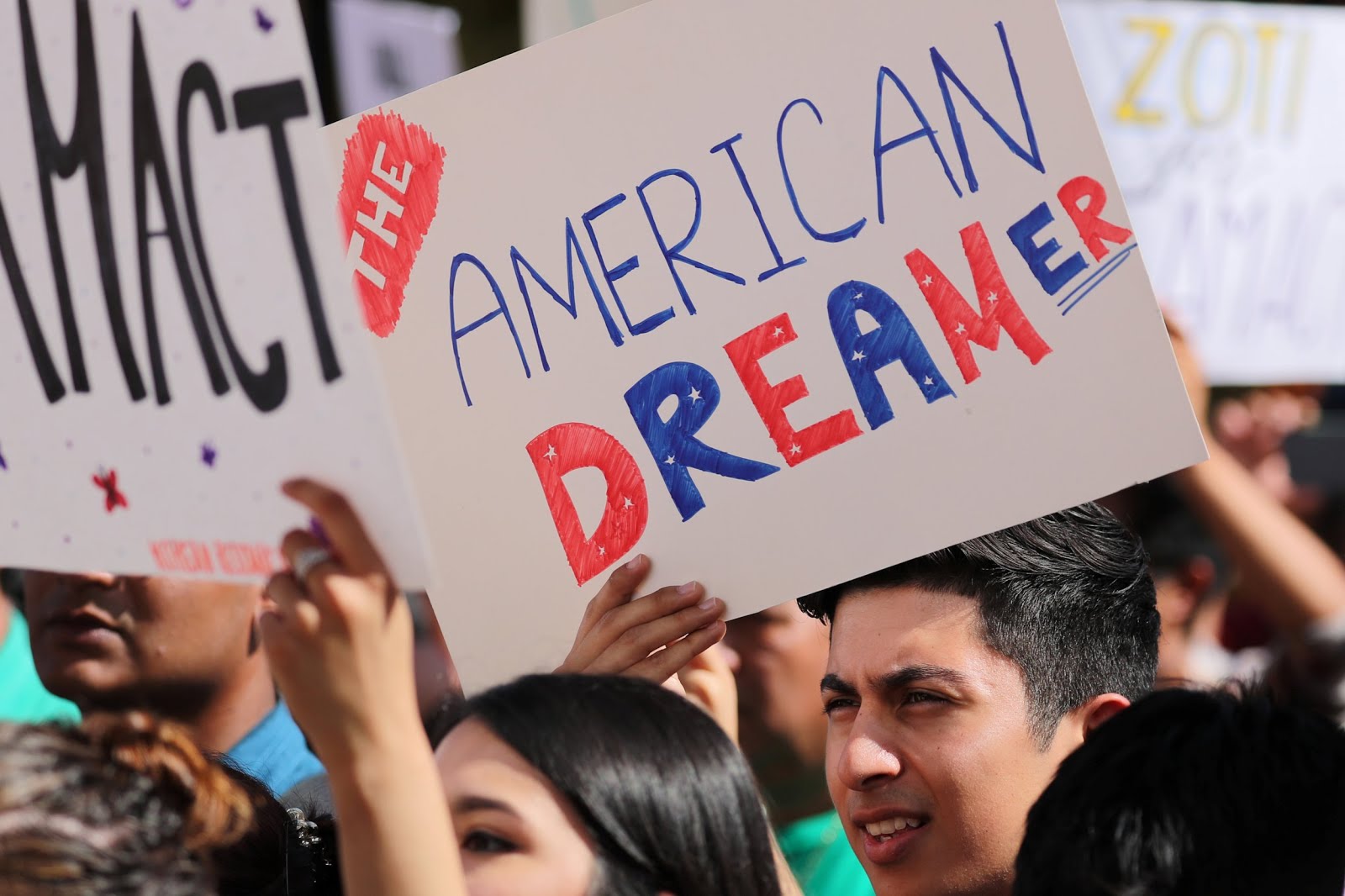
Those protected under DACA, Deferred Action for Childhood arrivals, are known as “Dreamers” (often spelled “DREAMers”).

DACA is an American immigration policy that allows some individuals with unlawful presence in the United States after being brought to the country as children to receive a renewable two-year period of deferred action from deportation and become eligible for a work permit in the U.S. To be eligible for the program, recipients cannot have felonies or serious misdemeanors on their records.

The policy, an executive branch memorandum, was announced by President Barack Obama on June 15, 2012. U.S. Citizenship and Immigration Services (USCIS) began accepting applications for the program on August 15, 2012.

To apply, a Dreamer must have been younger than 31 on June 15, 2012, when the program began, and “undocumented,” lacking legal immigration status. They must have arrived in the U.S. before turning 16 and lived there continuously since June 2007.

These young immigrants were required to to be strictly vetted. This included undergoing criminal and security screenings and additional checks every 24 months. Some 700,000 young people in the U.S. are shielded from deportation by the DACA program.

Most Dreamers are from Mexico, El Salvador, Guatemala and Honduras and the largest numbers live in California, Texas, Florida and New York. They range in age from 15 to 36, according to the White House.

While the majority of Dreamers are Latino, they are a diverse group and come from a multitude of countries and cultures. Seven of the top 24 countries for Dreamers are in Asia, Europe, or the Caribbean. Tens of thousands of young Dreamers come from South Korea, the Philippines, India, Jamaica, Tobago, Poland, Nigeria, Pakistan, Brazil, the Dominican Republic, and Guyana.

Education and Work

DACA recipients grew up in the United States and have established their lives and futures in the country. Beyond that, they are contributing to the economy in ways that benefit the entire nation. Center for American Progress DACA recipient arrived in the United States in 1999, when they were just 7 years old. More than one-third of DACA recipients, 37 percent, arrived before age 5.

Immigration advocates say that even though DACA recipients can’t receive federal aid, the program has made it much easier to get a college education. Sixteen states allow DACA students to pay in-state tuition at state universities; major scholarship funds like TheDream.us help Dreamers foot the tab for tuition (Amazon founder Jeff Bezos recently donated $33 million), and DACA allows students to work jobs and earn money.

According to a University of California study in collaboration with the immigrant-advocacy group United We Dream and the left-leaning Center for American Progress, 45% of DACA recipients are in school, and nearly three-quarters of those are pursuing a bachelor’s degree or higher. Of the group that isn’t currently in school, many have already graduated.

(Charlotte Alter/Lorain. “A Dreamer’s Life.” Time. March 6m 2018.)

Over the past five years, 91% of DACA recipients have found gainful employment, and are currently working for companies across the country. The largest occupation groups for DACA recipients are food preparation and office and administrative support at 66,000 workers each, as well as sales at 61,000 workers. Other notable fields include management and business occupations, in which 28,000 DACA recipients are employed; education and training occupations, with 16,000 DACA recipients employed; and health care practitioner and support occupations, with 27,000 DACA recipients employed.

These individuals work in different sectors of the economy too. According to the CAP analysis of ACS microdata, nearly 6,000 DACA recipients are self-employed in an incorporated business, while 25,000 work in nonprofit organizations and 22,000 work in the public sector.

( Wong, T., Rosas, G., Luna, A., Manning, H., Reyna, A., O’Shea, P., Jawetz, T. and Wolgin, P. DACA Recipients’ Economic and Educational Gains Continue to Grow. Center for American Progress. 2017.)

900 DACA recipients serve in the military. These individuals are part of the Military Accessions Vital to the National Interest (MAVNI) Pilot Program. The Department of Defense is coordinating with the Departments of Justice and Homeland Security (DHS) regarding any impact a change in policy may have for DACA recipients.

Economic Impact

DACA recipients and their households pay $5.7 billion in federal taxes and $3.1 billion in state and local taxes annually. In addition to this, DACA recipients boost Social Security and Medicare through payroll taxes. DACA recipients and their households hold a combined $24.1 billion in spending power – or income remaining after paying taxes – each year.

As community members, DACA recipients make substantial rental and mortgage payments, much of which goes directly into their local economies. DACA recipients own 59,000 homes and are directly responsible for $613.8 million in annual mortgage payments. Rental payments are even more staggering: DACA recipients pay $2.3 billion in rent to their landlords each year

(CAP analysis of 2017 1-year American Community Survey microdata,
accessed via the University of Minnesota’s IPUMS USA.)

DACA Revocation

Individuals who pose a public safety threat due to their criminal history or gang affiliation are subject to DACA revocation Only 0.2% of DACA enrollees have had their status revoked because of criminal or gang activity.

A Citizenship and Immigration Services spokesperson said nearly 90 percent of DACA revocations were the result of participants being linked to “alien smuggling, assaultive offenses, domestic violence, drug offenses, DUI, larceny and thefts, criminal trespass and burglary, sexual offenses with minors, other sex offenses and weapons offenses.” Roughly 3 percent were for alleged “gang activity,” and 7 percent were for a variety of relatively minor offenses, such as making a false claim of citizenship or collecting three or more misdemeanor convictions.

The exact nature of the crimes triggering DACA revocation and subsequent deportation remains unclear. For example, a “drug offense” could amount to nothing more than “a dime bag of marijuana possession.” Citizenship and Immigration Services declined to provide a detailed breakdown of the offenses.

Trump signed an executive order during his first week in office that makes virtually everyone who is in the country without authorization a priority for deportation, including those who have been only accused, not convicted, of crimes.

(Keegan Hamilton. “Trump told Dreamers to 'rest easy,' but here’s proof they shouldn’t.” Vice News. May 3 2017.)

Without DACA

Dreamers live under a dark cloud of fear because for years their voices have been silenced. Without DACA in place, every individual who was under the protection of the program will lose their jobs and potentially their right to live in the U.S.

Allowing DACA to end would leave hundreds of thousands of young people unable to work lawfully in this country and expose them to the threat of detention and deportation. Not only would this be heartless, but it would also jeopardize the many contributions that DACA recipients make to U.S. society and the national, state, and local economies every day.

Hey, Trump, I know you weren't loved enough
By your sandpaper father, who roughed and roughed

And roughed the world. I have some empathy
For the boy you were. But, damn, your incivility,

Your volcanic hostility, your lists
Of enemies, your moral apocalypse –

All of it makes you dumb and dangerous.
You are the Antichrist we need to antitrust.

Or maybe you're only a minor league
Dictator—temporary, small, and weak.

You've wounded our country. It might heal.
And yet, I think of what you've revealed

About the millions and millions of people
Who worship beneath your tarnished steeple.

Those folks admire your lack of compassion.
They think it's honest and wonderfully old-fashioned.

They call you traditional and Christian.
LOL! You've given them permission

To be callous. They have been rewarded
For being heavily armed and heavily guarded.

You've convinced them that their deadly sins
(Envy, wrath, greed) have transformed into wins.

From “Hymn” by Sherman Alexie


Friday, September 27, 2019

Hank Williams: Recalling the Last Ride


"I don’t write ‘em. I just hang onto the pen and God sends ‘em through.”

– Hank Williams

Hiram “Hank” Williams ranks among the most powerfully iconic figures in American music. As Williams became one of America's first country music stars, he set the bar for contemporary country songcraft. No one has eclipsed his great influence in the genre, and it's likely no one ever will. 

Williams composed thirty-one of the singles he released during his six-year career; as well as posthumous work including: singles, compilation albums, and previously unreleased material. During his lifetime, he placed thirty songs on Billboard's Top C&W Records, while he had seven number one hits. Almost 100 of his songs came into national prominence.

Of Williams' many songs, these are just ten of the more memorable works:
    "I'm So Lonesome I Could Cry"
    "I Saw the Light"
    "Your Cheatin' Heart"
    "Ramblin' Man"
    "Moanin' the Blues"
    "Kaw-Liga"
    "Move It On Over"
    "Cold, Cold Heart"
    “I Can't Help It (If I'm Still in Love With You)”
    “Lovesick Blues”
The incredible simplicity and stark emotional impact of Hank's music has been long noted as the alchemy of a musical genius. Andrew Romano, senior writer for Newsweek and The Daily Beast wrote ...

“His (William's) work was a perfect storm of sorts. Individually, every element of a Williams record – his lyrics, his music, his voice – was memorable. But it's the way those parts combined into a seemingly inevitable whole – the way they reflected and amplified each other – that made him great, rather than merely good.

“Hank's music—a blend of the blues he learned from a local busker and the Appalachian hill songs he heard at home—served as a kind of musical onomatopoeia for heartbreak; his lyrics put that feeling into words. They locked together like puzzle pieces: note by note, syllable by syllable.

And then there was Williams's voice: a seismic instrument that registered every shockwave of sadness or rage as it reverberated outward from somewhere inside him. He wasn't just singing about heartbreak; he actually sounded heartbroken. That's why "I'm So Lonesome I Could Cry" seems indivisible: like all the best pop records, it convinces the listener that only this voice could sing those words over that melody. It couldn't exist in any other form.”

(Andrew Romano. “The Ghostwriter.” GQ. October 3, 2011.)

With an $8 guitar and a melancholy voice, Williams, a poor Alabama country boy, set out on his meteoric rise to fame and fortune. Reflecting his own troubled experiences, most his songs portrayed the love and loss of sad and lonesome souls. Although he left an incredible body of songs, it is notable that upon departing his brief life, he left no in-depth interviews and just a few letters. According to songwriter Danny Dill, Hank held a fascination for the dark side of life.

“Did you ever see a robin weep
When leaves began to die?
Like me, he's lost the will to live
I'm so lonesome I could cry”

“I'm So Lonesome I Could Cry” Hank Williams

In 1952 alone, despite physical deterioration, he recorded 89 songs. In the same year, his public drunkenness led the Grand Ole Opry to fire him. Williams had missed an appearance two days earlier, and it wasn’t the first time. A heavy drinker caught up in a barely-understood addiction to painkillers, the singer’s behavior had becoming increasingly erratic – something especially troubling to the music establishment.

“I can settle down and be doin' just fine
Til' I hear an old train rollin' down the line
Then I hurry straight home and pack
And if I didn't go, I believe I'd blow my stack”

“Ramblin' Man” Hank Williams

The Opry has always said they never intended Williams’ removal to be permanent. The Mother Church of Country Music claimed it was meant as a wake-up call for the troubled artist. A psychiatrist once described Hank "as the most lonesome, the saddest, most tortured and frustrated of individuals."

Hank’s life was a series of contradictions. Rush Evans writes in Goldmine …

“He was an alcoholic who could undergo long periods of sobriety. He sang songs of the wild life and songs of faith. He was a reckless playboy and a devoted family man. He was an upbeat guy with mean old miseries in his soul. He was an uneducated hillbilly and a creative genius. And most of all, he was a man with a carefree attitude about life who also had a remarkable ability to articulate any human feeling with depth and despair at the Shakespearean level.”

“When you are sad and lonely and have no place to go
Call me up, sweet baby, and bring along some dough
And we'll go Honky Tonkin', Honky Tonkin'
Honky Tonkin', Honey Baby
We'll go Honky Tonkin' 'round this town.”

"Honky Tonkin'” Hank Williams

Williams was born with a mild undiagnosed case of spina bifida occulta, a disorder of the spinal column, which gave him lifelong pain – a factor in his later abuse of alcohol and other drugs. To make matters worse, in 1951 Williams fell during a hunting trip in Tennessee, reactivating his old back pains and causing him to be dependent on alcohol and prescription drugs.

By the end of 1952, Williams had started to suffer heart problems. He met Horace Raphol "Toby" Marshall in Oklahoma City, who claimed to be a doctor. Marshall had been previously convicted for forgery, and had been paroled and released from the Oklahoma State Penitentiary in 1951. Among other fake titles he claimed to be a Doctor of Science. He purchased the DSC title for $35 from the "Chicago School of Applied Science.” Under the name of Dr. C. W. Lemon he prescribed Williams with amphetamines, Seconal, chloral hydrate, and morphine.

“I was just a lad, nearly twenty two
Neither good nor bad, just a kid like you
And now I'm lost, too late to pray
Lord I paid a cost on the lost highway”

“Lost Highway” Hank Williams

One of Hank’s band members, Tommy Hill, described the daily routine as they toured the country playing one-nighters:

“Me and a bunch of the pickers talked about how [Hank’s manager] Clyde Perdue and Toby Marshall were just in it for what they could get out of Hank cause he was making pretty fair money. But Hank never saw any of it. You see, if Hank took one shot of whiskey, he was drunk, so they’d get a six-pack and allot him so many beers after he woke up until the time of the show and that kept Hank happy. Then the doctor would give him a shot so he’d lose all his beer, throw it all up, then they’d put black coffee down him, let him do the show, then give him a six-pack and put him to bed. Same thing every day. I said, ‘They’re killing him.’ The booker and the doctor.”

(Robert A. Waters. “Last Ride down the Lost Highway.” November 12, 2011.)

The story of Williams' tragic death at age 29 has been the subject of a multitude of books, songs, and personal accounts. Lore began growing around the event from day one. H.B. Teeter, newspaperman for the Nashville Tennessean, published an article one day after Williams' death claiming Williams had told him months before in an interview – “I will never live long enough for you to write a story about me.”

“If it was rainin' gold I wouldn't stand a chance
I wouldn't have a pocket in my patched up pants
No matter how I struggle and strive
I'll never get out of this world alive”

"I'll Never Get Out Of This World Alive" Hank Williams


The Last Journey of Hank Williams

Note: Much of the evidence for the report of Hank Williams' last days here are excerpted and paraphrased from Hank: The Short Life and Long Country Road of Hank Williams (2017) by Mark Ribowsky.

Ironically Williams' single, “I'll Never Get Out of This World Alive,” was scaling the top-ten at the time of his demise. On Monday, December 29, 1952, Hank is reported to have made a rare and unexpected visit to church, St. Jude’s Hospital chapel, to pray with the nuns. “Ol’ Hank needs to straighten up some things with the Man,” his wife Billie Jean said he told her. It was his last full day in Montgomery.

“I wandered so aimless life filled with sin
I wouldn't let my dear savior in
Then Jesus came like a stranger in the night
Praise the Lord I saw the light”

"I Saw The Light" Hank Williams

Williams was booked to play two venues – one in Charleston, West Virginia, and one in Canton, Ohio. Before he left, Williams came into his cousin Marie McNeil’s room and handed her forty dollars, which he wanted used to help pay the doctor who would deliver Bobbie Jett’s baby. As he left the room, Marie said, Hank told her, “Ol’ Hank’s not gonna be with you another Christmas. I’m closer to the Lord than I’ve ever been in my life.”

Note – Bobbie Jett had a brief relationship with Hank Williams between his two marriages. Their baby, Antha Belle Jett (Jett Williams) was born on January 6, 1953, in Montgomery, Alabama, five days after her father's death on January 1.

Jett was adopted by Hank's mother Lillie Stone. But when Stone died herself just two years later, Jett was put into foster care. After a lengthy court battle in the 1980s, she was ruled to be one of her father's legal heirs and due to half of the family fortune. In 1990, Jett told her story in the memoir Ain't Nothin' as Sweet as My Baby.

The next morning, December 30, Hank's travel plans still in limbo, he chartered a flight to Charleston for early afternoon. But because of the horrendous weather – a snow-storm had blanketed Montgomery, one of the few to ever hit the city – he had hired a driver days before. Because of his reputation for missing shows he couldn’t afford more bad publicity.

Williams hired 17-year-old Charles Carr, son of Dan Carr, owner of Lee Street Taxi, to drive him on the four-day, two show, round trip. Although Billie Jean expressed her desire to go with him, Hank left alone. According to Billie Jean, Hank had spent a restless night in bed with excruciating back pain. She feared something more was wrong.

Around 11:30 a.m. Hank and Carr loaded up his baby blue ’52 Cadillac convertible. He had Carr buzz the airport to check on a plane before they left, but all flights were canceled well into the day. Hank settled in, his back already hurting, for what would be hours on the road.
“Oh, the blues come around
Oh the blues come around
Lawd, the blues come around
Ev'ry evenin' when the sun goes down”

“The Blues Come Around” Hank Williams

Before they left, Williams also had the driver stop by a doctor, identified in one account only as a man named “Black,” who shot him up with morphine. After buying some sandwiches, coffee, and a six pack of Falstaff beer at the Hollywood Drive-in Diner, Hank headed north on Highway 31.

“I'll gas up my hot rod stoker we'll get hotter than a poker
You'll be broke but I'll be broker tonight we're settin' the woods on fire
We'll sit close to one another up one street and down the other
We'll have us a time oh brother settin' the woods on fire
We'll put aside a little time to fix a flat or two
My tires and tubes are doin' fine but the air is showin' through
You clap hands and I'll start bowin' we'll do all the laws allowin'
Tomorrow I'll be right back plowin' settin' the woods on fire”

“Settin' the Woods on Fire” Hank Williams

The itinerary covered nearly a thousand miles, from Montgomery to Charleston to Canton. Because Hank had gotten out of Montgomery late, he decided to stay the night in Birmingham, where they got a decent night's sleep at the Redmont Hotel. They were off early the next morning, New Year's Eve day, and they made a stop in Fort Payne, where Hank bought a bottle of bourbon. The duo made it to Chattanooga by lunchtime and ate in a diner.

By 1:00 p.m. they were in Knoxville, still three hundred miles from Charleston. In Knoxville, Williams found his way to St. Mary’s Hospital, where, in mysterious circumstances Carr never explained, he was able to have a doctor give him another morphine shot.

By then, as Carr learned when he phoned Lillie, Hank's mother, the two Charleston shows had been canceled due to the storm. Meanwhile, stuck back in Knoxville, Carr and a dog-tired Hank checked into the Andrew Johnson Hotel. Hank, who had drained the bourbon, could barely stand, and two porters all but carried him to his room.

“Well I stopped into every place in town
This city life has really got me down
I got the honky tonk blues,
Yeah the honky tonk blues
Well Lord I got em,
got the ho-on-ky tonk blues.”

“Honky Tonk Blues” Hank Willliams

At the hotel, Hank was laid out on his bed, but was kept awake by nagging hiccups that seemed to approach convulsions. Carr notified the front desk to summon a doctor. Minutes later, Dr. Paul Cardwell rushed to the hotel and, possibly having conferred by phone with Marshall, injected Williams with two more morphine shots along with vitamin B-12.

Williams dozed off fully clothed, but about 10:30 p.m., Carr got a call from the concert promoter telling him they had to leave right away and drive through the night to make the Canton show.

The show’s promoter, A.V. “Bam” Bamford, was particularly peeved, knowing he’d be refunding two sellout houses of 4,000 people if Hank didn't show. Bam instructed all of them to get going to Canton for the next night’s shows. One other interested party had made it to Charleston as well – Toby Marshall, who called Lillie for his marching orders.

Note: Reportedly at the request of Hank Williams’ mother, Jessie Lillybelle Skipper Williams, Toby Marshall had flown to Charleston to look after Hank and to accompany him back to Montgomery following the Canton show. Marshall had been supplying Williams with the powerful sedative chloral hydrate, and appeared to have gained the trust of both Hank and his mother.

(John Lilly. “Hank Williams’ Lost Charleston Show.” Native Ground.)

"There was some kind of penalty clause in his contract . . . so we had to be there for the New Year's Day concert or else, " Charles Carr remembered.

"When we left the room, they sent a wheelchair, " Carr said. "They rolled him (Williams) down to the car and Hank got in on his own. I clearly remember that."

(Jim Tharpe. “At 17, Charles Carr was the only witness when a legend died, and myths were born.” The Atlanta Journal-Constitution. December 30, 2002.)

The roads were bad due to the weather and the traffic was slow. Carr got a ticket about an hour later in Blaine, Tennessee, when he almost ran into a patrolman while trying to pass another car. He paid a fine and got back behind the wheel with Williams asleep in the back. It was after midnight by this time – already New Year's Day – and Carr had been behind the wheel since early that morning.

“Like a bird that's lost its mate in flight
I'm alone and oh, so blue tonight
Like a piece of driftwood on the sea
May you never be alone like me”

"May You Never Be Alone" Hank Williams

The tired teenager stopped in a small town in the dead of night – maybe Bristol or Bluefield as Carr remembers – to gas up and get a bite to eat. He specifically remembers a service station on one side of the highway and a diner and a cab stand on the other.

"I remember Hank got out to stretch his legs and I asked him if he wanted a sandwich or something, " Carr said. "And he said, 'No, I just want to get some sleep.'

"I don't know if that's the last thing he said. But it's the last thing I remember him telling me."

At the cab stand, Carr picked up a relief driver who helped him drive for a few hours before getting out somewhere in rural West Virginia.

Carr drove on, but became increasingly concerned about the eerie silence in the back seat. He pulled off the road to check on Williams, who was lying with his head toward the passenger seat and had his left hand across his chest.

“Won't you redeem; your poor wicked soul
You can't pay your way; with Silver and Gold
If you're not saved; you'll be lost in the night
When the Pale Horse and his rider goes by?”

“The Pale Horse and His Rider” Hank Williams

From this point on, mysteries abound that have never been solved, mysteries with plenty of clues but a lot of doubt.

Carr would later say Williams had spent time writing songs and chugging some beer, and noted that the last song they sang was Red Foley’s “Midnight,” a song that may have matched the mood he was in as he sang for the last time:

“Midnight, oh what a lonely time to weep, I ought to know
Midnight, I should have been fast asleep hours ago …”

"He had his blue overcoat on and had a blanket over him that had fallen off, " Carr said. "I reached back to put the blanket back over him and I felt a little unnatural resistance from his arm."

Panicking, Carr rushed into the restaurant it’s unknown whether Surface and came back out with an older man who took a look at Hank Williams and summed up the situation with classic understatement.

“I think you got a problem,” he said.

Police reports would indicate that Carr, knowing they had a famous corpse in the back and needing to get it to a hospital, asked for directions to one at Burdette’s Pure Oil gas station. Carr asked the owner, Peter Burdette, to call the local police station and tell them a dead man had been driven into his place. Within minutes, a police car arrived, and Officer Orris Stamey confirmed Hank was dead.

The official cause of death, which was declared at Oak Hill Hospital, has also been reported several ways, both accurate, with the death certificate saying that the cause of death was “acute rt. ventricular dilation” and a later coroner’s jury declaring that he “died of a severe heart condition and hemorrhage.”

Because of the uncertainty about where Hank died and the fact that the West Virginia coroner ruled his death a heart attack, charges against Toby Marshall were never filed.

Defending his position, Marshall claimed that Williams possibly committed suicide. Marshall stated that Williams told him that he had decided to "destroy the Hank Williams that was making the money they were getting". He attributed the decision to Williams' declining career:

"Most of his bookings were of the honky-tonk beer joint variety that he simply hated. If he came to this conclusion (of suicide), he still had enough prestige left as a star to make a first-class production of it … whereas, six months from now, unless he pulled himself back up into some high-class bookings, he might have been playing for nickels and dimes on skid row."

A scrap of paper found on the floor of the car that carried Hank Williams to his death on New Year's Day, 1953, is reported to have read …

“We met we lived
And dear we loved
Then came that fatal day
The love that
Felt so dear fades far
Away
Tonight we both
Are all alone and here’s
All that I can say
I love you still and
Always will
But that’s the price
We have to pay”

Fifty-seven years after his death, Hank Williams received a special Pulitzer Prize citation for lifetime achievement in music. The Pulitzer board praised him as “a songwriter who expressed universal feelings with poignant simplicity.” Of his own life, Hank once told a reporter that the “people who has been raised something like the way the hillbilly has, knows what he is singing about and appreciates it.”

Whether you call him “Hillbilly Shakespeare” or “Luke the Drifter,” Hank Williams left an incredible body of brutally honest songs about his life in the language of the common man – he brought country music into the modern era, and his influence spilled over into the folk and rock arenas as well.