Showing posts with label enforcement of ohio smoking ban. Show all posts

Tuesday, November 3, 2009

Secondhand Smoke and Ohio: Tobacco and Marijuana


 According to Anderson's Revised Code of Ohio, possession of less than 100 grams of marijuana is a citable offense only, with a fine of $100. No criminal record is created by such citation. For all drug convictions, the offender's driver's license is also suspended for a period of 6 months - 5 years; however, this does not apply to minor misdemeanor violations for marijuana possession.

Under 3794.01 definition, (A) "Smoking means inhaling, exhaling, burning, or carrying any lighted cigar, cigarette, pipe, or other lighted smoking device for burning tobacco or any other plant. Smoking does not include the burning of incense in a religious ceremony."


 Some Fictional Fun

Let me create a fictional setting and circumstance. Say, Bobbie Stoner enters his Ohio private club, The Free Birds of America, that is currently not enforcing the smoking ban. He sits down, orders a drink, and lights up a marijuana joint. The manager, Tom Straight, observes the obvious violation of the law; however, he also observes several of his best patrons smoking cigarettes illegally in his establishment. What does he do? Does he ask Bobbie to leave, call law enforcement officers, or call the toll-free Ohio smoking ban enforcement number – 1-866-559-OHIO (6446)?

Is Tom putting himself and his business at risk for a lawsuit any way he handles this situation? After all, Tom is breaking the law himself by allowing SHS, secondhand smoke, to permeate the air. Bobbie, if arrested, could pay his fine of $100 and report the club for violation of the smoking ban. Shouldn't noncompliance, once already practiced, encourage Tom to let Bobbie's second offense slide? Who is really at fault in this situation? Under 3794.01 (A) smoking of any kind of plant is treated the same. If Tom ignores the marijuana, isn't he setting himself up for even more criminal behavior?

Silly, you say? The International Agency for Research on Cancer (an agency of the World Health Organization) determined that second-hand smoke causes cancer. The IARC reports states, "And we know that marijuana and cigarette smoke contain as many as 50 of the same cancer causing substances. For these reasons, experts believe that exposure to second-hand marijuana smoke is at least as harmful as second-hand tobacco smoke." So, the converse is true -- secondhand cigarette smoke is as harmful as second-hand tobacco smoke (without the possible contact buzz).


The Points Being:

I am NOT an advocate of smoking marijuana. The points are (1) The law is the law and must be obeyed by all of those whom it effects, and (2) Secondhand smoke is secondhand smoke, no matter whether the smoked plant is tobacco or marijuana.That is why the penalties for smoking in public in Ohio are relatively the same, whether a person is caught smoking tobacco or marijuana. 

How many private clubs condoning smoking during the ban are willing to stay open only for customers who smoke and ban those who don't smoke by the rules of club entry? None. That is because Federal and State laws make it illegal to discriminate in such a manner. The issue is about MONEY. Owners of clubs that are violating the law want to make their money and smoke it too.

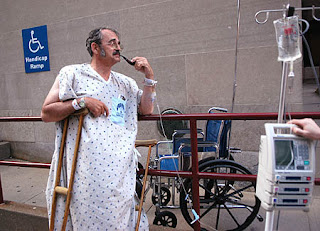
I used to laugh aloud when using the entrance to Southern Ohio Medical Center meant walking by the smoking facility set aside for the public and patients. There sat visitors and patients with IV's wafting clouds of smoke upon themselves and everyone else who entered the hospital. This went on for years at a health facility. The smoking area was to the left as you entered the hospital. I joked that the bar for alcoholics should be constructed on the right beside the same main entry. Equality for addictions.


Granted, taking away someone's habitual behaviors is difficult and not without extreme sacrifice for those who lose privilege. Still, I applaud those who are taking the opportunity to use the smoking ban as impetus for ceasing their habit. They are truly caring citizens, putting other people's safety ahead of their own interests. These folks are modern-day heroes, not afraid of facing suffering to improve themselves and to take care of their fellow man.


Cigarette Alternatives


Humans have been ingesting nicotine for thousands of years. Some of the new products are smokeless. There are snus -- little pouches of tobacco that users put in their cheeks -- and lozenges. There are also new variations on ancient ways to smoke. Hookahs, for example, are an ongoing trend with teenagers and young adults.

1. Josephine Marcotty reported on snus, "The newest tobacco products to arrive in the United States are snus, often described as spitless tobacco. Snus alarm health advocates because the tobacco companies market them as a replacement for cigarettes in places where people can't smoke." Camel SNUS, which are now being test marketed in a few U.S. cities, come with the tag line "pleasure for whenever." (Minneapolis/St. Paul Star Tribune, October 25 2007) At least, snus create no secondhand smoke.

Research shows that they have fewer carcinogens than other sorts of tobacco products but just as much nicotine, Hatsukami said. They could help people quit smoking or it could just keep smokers addicted.

2. And ABC News (June 24 2006) reported, "There's a whole new way for smokers to get a fix -- a lemon-flavored drink laced with nicotine." Nic Time, the company that makes Nic Lite, says its meant to tide over smokers when they can't light up on a plane or a bar.

But critics say it could be one more way for young people to get hooked. An 8-ounce bottle contains the same amount of nicotine as two cigarettes. Nic Lite was first available at Los Angeles International Airport for smokers who get fidgety on flights. Now, some convenience stores also stock it.

The company's Web site says it would also like to offer Nic Lite in bars, since more and more of them are smoke free. (abcnews.go.com)


Bottle of NIC

Monday, November 2, 2009

Smoke, Smoke, Smoke


 The Smoking Report

Local attorney Jeremy Burnside in the Portsmouth Daily Times wrote about the public's reaction to the November 2006 election. In that election, Ohio voters passed Issue 5 with 2.2 million voters supporting a smoking ban in all Ohio workplaces, including private clubs. The Ohio Department of Health estimates there are about 280,000 public places and places of employment covered by the ban designed to eliminate exposure to second hand smoke.(Christine L. Pratt, The Daily Record, Wooster, May 22 2009)

The law calls for a graduated series of punishments: After an initial warning, a second violation is $100, growing to $2,500 for fifth and subsequent violations.

In a July 2008 letter to Smoke Free Ohio, an American Cancer Society-spearheaded campaign in opposition to all things smoke, Sen. William Seitz (R- Cincinnati) voiced dissatisfaction with the ballot language exclusion when he called it “misleading.” Senator Seitz cosponsored a 2008 bill that allowed exemptions to private clubs. The 2008 bill, however, didn’t have enough momentum to move out of the Health, Human Services, and Aging Committee.

Sen. Bob Schuler (R- Cincinnati), brought a similar bill to life with his introduction of Senate Bill 120. Senate Bill 120 contains beefed-up smoking ban exemptions for outdoor patios, cigar bars, retail tobacco stores, family-owned businesses and not-for-profit private clubs. Senator Schuler, unfortunately, died in June 2009. Currently, the bill has less than half of Senator Schuler’s 2008 cosponsors, all Republicans, and is in a different committee with no signs of a pulse and apparently no House bill to compliment it.

Now, some bars owners believe the smoking ban helped their businesses while others claim the ban has destroyed them.

According to a Dayton Daily News analysis of the state smoking complaint data. Of the top 10 targets of smoking complaints in the state, eight are private clubs. (Ken McCall, December 23 2007)


Burnside writes, "Maverick bar owners are still holding firm and fighting for their rights and against the smoking ban in court and in the media. Champions of the ban and sworn enemies of second-hand smoke will continue to claim success and a healthier America. Unless Ohio courts overturn the ban, which is not likely, but not impossible on some constitutional ground, or smoking ever becomes “cool” again, the smoking ban is here to stay."


 Portsmouth Smoking Reality

As far as I know, the smoking ban is not being enforced in private establishments in Portsmouth, Ohio. I have been told that the owners/managers resist enforcing the ban because of the impact due to a tremendous decline in business when the ban is strictly monitored. The fear of paying stiff fines for violation of the ban is not working. Evidently, enforcement of the ban is lacking the manpower or the willpower to force these establishments into compliance. I was unable to find statistics on the number of warnings and citations issued in Scioto County.

All in all, the new State law and the present smoky environments represent a laughable circus. Everyone knows the law and no one cares about anything except their so-called "personal rights." Issues of health, membership privilege, comfort, relaxation, addiction, stress, infringement, tradition, and freedom are all worn on the sleeves of customers. In the meantime, unhappy non-smokers feel threatened to report those who smoke. Smoke fills the air and the alternative is to leave the establishment if it bothers you.

Here is the bottom line. This issue is not one of personal rights or health. The issue of smoking in private bars relates directly to MONEY. Many people who drink, gamble, and seek company are addicted to smoking. It's that simple.The law requiring the ban, the infringement upon non-smokers' legal rights, and the scientific proof that second-hand smoke does harm others DOES NOT MATTER to those with a smoking addiction. They must smoke, so the bar IGNORES THE LAW TO KEEP PATRONAGE AND TO MAKE MORE MONEY.

Now, the situation in these bars is as if no speed limit exists on State Route 23 -- owners allow customers to operate with lawless abandon as they recklessly puff away. Ask owners and managers about self-enforcing the ban: they will tell you that enforcement, according to present law, will spell "the end" to their business. Then, they will add that no establishments (their competition) are operating within the law.


Courts And Fines

According to Toledo's WTOL 11 News (February 20, 2008), not only are some bars not paying fines, they're also working together, says Dr. David Grossman, with the Health Department. Grossman says when health inspectors are investigating complaints, a small network of bars start informing each other by phone. "It's kind of in a way like bootleggers," Grossman says. Also, bars are establishing kitties to pay for fines and handing out Styrofoam cups and other such vehicles for disposable ashtrays.

Lawsuits have been filed by some establishments that have been fined contending that the law is too vague in ordering that business owners take "reasonable steps" if a patron is caught smoking and that the Ohio Department of Health is not properly interpreting the law. Such owners believe that complying with the law merely means posting signs, removing ashtrays and telling patrons not to smoke there. (Dayton Daily News, September 19 2009)

A news release by Richard Cordray, Ohio Attorney General, and Ohio Department of Health (ODH) Director Alvin D. Jackson, M.D., (August 14 2009) announced the first lawsuits filed against Ohio establishments for violations of the Smoke-free Workplace Act. Complaints were filed in Hamilton County Court of Common Pleas against O'Neal's Tavern in Cincinnati and in Franklin County Court of Common Pleas against Zeno's in Columbus.

Cordray reported, "The complaints seek a court order requiring the bars to comply with the state smoking ban. The suits were brought against these establishments because of their repeated and extensive violations over the last two years. According to court documents, O'Neal's Tavern has been cited for 12 violations accruing fines of more than $21,000, and Zeno's has been cited for nine violations and fines of more than $28,000."

"The issue at hand is clear disregard for Ohio law," said Cordray. "These establishments have been warned and fined repeatedly over a two-year period to no avail. They continuously push the limits and have given us no alternative but to seek the court's intervention." (www.ohioattorneygeneral.gov)

To date, more than 3,100 warning letters have been issued to violators and more than 1,800 fines assessed. Some establishments find it cheaper to hire a lawyer to fight the fines than pay them.

Imagine, if you will, a relatively small private bar or club so attractive in its concept, entertainment, and appeal that people felt obliged to attend -- the perfect "in" place for all legal ages. Would smokers join the droves that frequent such a place if it were operating within the smoking ban? I wonder. Would they contain their habit?


Vaporette with plastic ash

A Smoking Alternative While Barhopping or Clubbing

In the meantime, a new invention from China is offering smokers an alternative to traditional cigarette.
Called a "Vaporette," the device is a cigarette replica containing a packet of liquid nicotine, without the flame, ash, tobacco, tar or carbon monoxide contained in traditional cigarettes. (Amy L. Payne, Bay City News www.mlive.com/news, May 16 2009)
When a user inhales through the device's filter, air flow is detected by a sensor, activating a heating element vaporizing nicotine contained in the mouthpiece. Upon exhaling, the user releases a puff of quickly dissipating water vapor, resembling smoke.

Each Vaporette kit comes with eight changeable filters, two of each containing eight, six, four and zero milligrams of nicotine. Each filter lasts approximately as long as two packs of cigarettes. The kit also comes with a USB cable to charge the Vaporette's battery off a home computer.

It costs about the same as one carton of cigarettes. However, to buy a single filter costs less than a dollar.
As Vaporettes are flameless and smokeless, users can puff on them in many nonsmoking areas.

The Food and Drug Administration has not approved the device and considers it a drug. The agency is currently attempting to block importation of electronic cigarettes, but is not seizing products already sold in the U.S.