
"...there will be within the next generation or so a pharmacological method of making people love their servitude, and producing a kind of painless concentration camp for entire societies, so that people will in fact have their liberties taken away from them but will rather enjoy it, because they will be distracted from any desire to rebel by propaganda, brainwashing or brainwashing enhanced by pharmacological methods." ~Aldous Huxley, (1959)

Published almost eighty years ago, Brave New World (1932) by Aldous Huxley remains a classic anti-Utopian novel. In the book, a futuristic ideal world is portrayed: one where human values are eliminated. The characters in Brave New World are all a part of a totalitarian state. They are free from war, hatred, poverty, disease and pain. Each one of the characters are hurt and altered by the huge consumption of a drug; since no one thinks questions or believes, all emotions are not real and any conscious reaction is susceptible to alteration by the effects of the drug,
In Brave New World, mankind exists in an institutional form of happiness, managed by the World State that uses "Community, Identity, Stability as its motto. The World State is a peaceful, stable global society. (Specifically because the population is permanently limited to no more than two billion people)
The World State is built upon the principles of Henry Ford's assembly line of mass production, homogeneity, predictability, and consumption of disposable consumer goods. At the same time as the World State lacks any supernatural-based religions, Ford himself is revered as a deity, and characters celebrate Ford Day and swear oaths by his name (e.g., "By Ford!").
Reproduction is totally controlled through genetic engineering as people are bred into a rigid class system of five castes (The lower castes are treated to chemical interference to cause arrested development in intelligence or physical growth.) and designed for specific purposes. Concepts such as family, freedom, love and culture are considered particularly grotesque as their sacrifice is the price of universal happiness. For example, children, controlled by the state, are encouraged to play "Erotic Play," in which they explore one another's bodies to prevent any feelings of guilt about sex.
In the World State, people typically die at 60, having maintained good health and youthfulness their whole life. Death isn't feared because anyone reflecting upon it is reassured by the knowledge that everyone is happy, and that society goes on. Since no one has family anyway, they have no ties to mourn.
Maturity is totally controlled by State conditioning that reinforces happiness with the roles for which society created the citizens. They, thus, work without complaint or incident. Besides work, the rest of their lives is devoted to pursuit of pleasure through promiscuous sex without remance (repeated in the maxim "everyone belongs to everyone else"), recreation such as the "feelies" (a sensory experience like Cinerama on tactile steroids), material possessions, and, of course, soma. Soma is the cure-all of government choice.

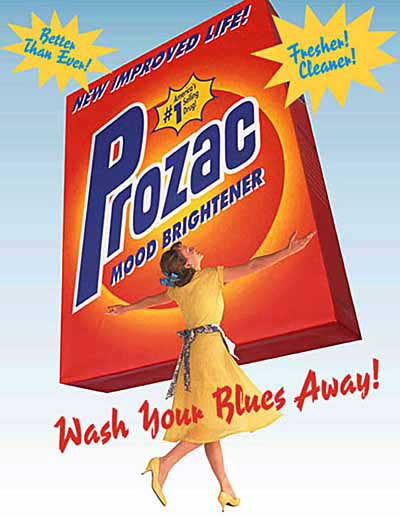
Soma acts as a hallucinogen that takes users on enjoyable, hangover-free "holidays." It is said also to replicate religious experiences, eliminating the need for religion.Yet, soma is more akin to a tranquillizer or to an opiate - or even to a psychic anesthetizing SSRI (selective serotonin reuptake inhibitors) like Prozac - than to a truly life-transforming elixir.
The lower caste people get their soma-ration every day and swallow it although it shortens their lives. With soma the citizens of the brave new world can compensate emotional stress. If they feel sorrow, pain, anger, jealousy or other negative emotions, the universal solution always is soma. So, soma is a remedy to reduce aggression and discontent to a minimum, and it helps the State to keep the social stability in the brave new world.
Another purpose for soma usage is for sick and dying people. In hospitals patients get huge concentrations of soma to ease their suffering and pain especially before death. Soma makes death as pleasant as possible for the sufferers. But, the consumption of soma also causes these patients not to be able to think clearly any more, and they stay drugged until they are dead. Of course, exaggerated consumption of soma can lead to the premature death of people who are otherwise well. Overdose is possible without precaution.
Some inhabitants of the World State do take huge portions of soma just to repress memories of their past bad experiences in the less-civilized world of the primitive reservation, where people preserve the outdated ways of the old culture. This is an extreme example of how people escape the reality of the World State by taking soma. But there are far more other drugs offered by the Internal and External Secretion Trust, which is in charge of hormones and medicines to keep people fit, young-looking and happy.
Huxley's View

Tragically, Brave New World, a satirical piece of fiction, has come to serve as the false symbol for any regime of universal happiness. The drug soma provides a mindless, inauthentic "imbecile happiness" - escapism which makes people comfortable with their lack of freedom. The drug heightens suggestibility, leaving its users vulnerable to government propaganda. Soma is just a narcotic that raises "a quite impenetrable wall between the actual universe and their minds." Their pleasure increases ignorance of self.
Huxley is warning us about becoming duped by science. The majority of people in the book are victims of propaganda and misinformation in their hedonistic society. He shows us how zombified addicts, willing to risk all individuality and self-initiated intelligence, can become slaves -- slaves to a society that freely dispenses pleasure or slaves to a state that completely controls individual freedoms through government. And, the cost in human life is terribly high in either or both cases. What appears Utopian living is anything but such a free and happy existence.
So, what brave new world awaits us in a free-market of psychotropic drugs? Will new medical drug cartels leave smuggling and operating "pill mills" for the Net as a global drug-delivery system? Opiates are quickly becoming the soma of the masses. Many would gladly exchange years of their lives for worry-free, pleasurable lives. These are people who would bend to governmental control for materialistic gain.
As trends of fiction have become obvious traits of 21st century reality, we are confronted with considering certain limits imposed upon us by the state and by big business. Chief among them is the all too convenient access to prescription drugs and the loss of security in our neighborhoods due to the enormous volume of drug dealing and all the crime and tragedy that accompanies it. We must make the government change the laws in our favor, make the government invest in sufficient law enforcement, and make the government instill programs that effectively curb skyrocketing addiction. This is fact, not fiction.
Social critic Neil Postman (Amusing Ourselves To Death, 1983) finds these startling comparisons as he contrasts America today with the World State in Huxley's Brave New World.
1. Huxley feared was that there would be no reason to ban a book, for there would be no one who wanted to read one.
2. Huxley said of information, he feared those who would give us so much that we would be reduced to passivity and egoism.
3. Huxley feared the truth would be drowned in a sea of irrelevance.
4. Huxley feared that what we desire will ruin us.


