Showing posts with label fighting taliban. Show all posts

Sunday, August 9, 2009

Is Killing a Moral Action?

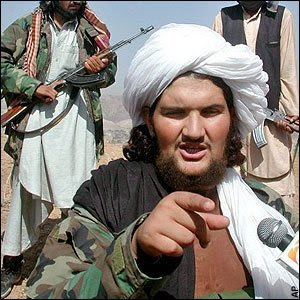
Baitullah Mehsud
From: FOXNews.com August 07, 2009 "An American drone aircraft wasted Pakistan's Osama-in-Waiting, Baitullah Mehsud in South Waziristan.

Mehsud was one of the nastiest characters on the planet. He is thought to be behind Benazir Bhutto's assassination in 2007. He was the mastermind of the wave of suicide bombings in Pakistani cities. He was the godfather of a new type of suicide bomber -- young children under the age of ten who he had strapped with explosives and sent out on suicide missions. He was the leader of the Pakistani Taliban, and closely associated with Al Qaeda and their host and collaborator. He was bent on bringing down the Islamabad government."

Some of Mehsud's fondest thoughts were: "We want to eradicate Britain and America, and to shatter the arrogance and tyranny of the infidels. We pray that Allah will enable us to destroy the White House, New York and London." And what do you think was Mehsud's weapon of choice? Pakistan's hundred or so nuclear weapons.

The Right To Life

True, the right to life -- of human beings -- is a rarely questioned fundamental moral principle. Western cultures assume it to be inalienable and indivisible. But, is it really either. The right to life may be a cultural construct, dependent on social mores, historical contexts, and exegetic (critical analysis) systems. (Dr. Sam Vaknin, Malignant Self Love, 2007)

Vaknin says this about the right to life, "It is a compendium of no less than eight distinct rights: the right to be brought to life, the right to be born, the right to have one's life maintained, the right not to be killed, the right to have one's life saved, the right to save one's life (wrongly reduced to the right to self-defence), the right to terminate one's life, and the right to have one's life terminated." (Sam Vaknin, "The Myth of the Right to Life," 2005)

None of these rights is self-evident, or unambiguous, or universal, or immutable, or automatically applicable.

For example, Vaknin says that Judaism and other religious, moral and legal systems accept that people have the right to kill a pursuer who knowingly and intentionally is bent on taking their lives. Within this framework, hunting down Osama bin-Laden and his henchmen in Afghanistan or Pakistan is morally acceptable (though not morally mandatory).

If the Archimedean point of moral reference is studied - does A's right not to be killed mean that third parties are to refrain from enforcing the rights of other people against A? What if the only way to right wrongs committed by A against others - was to kill A? The moral obligation to right wrongs is about restoring the rights of the wronged. If the continued existence of A is predicated on the repeated and continuous violation of the rights of others - and these other people object to it - then A must be killed if that is the only way to right the wrong and re-assert the rights of A's victims.

What the Hadith Says About Life

Read this quote from the Hadith. In Islam, the Hadith is tradition based on reports of the sayings and activities of Muhammad and his companions. Terrorist leaders use such passages to justify Jihad as total warfare. Other verses have justified sadistic Islamic beheadings as "strike at the necks" commands to avoid striking elsewhere so as to confirm death and not simply wound.

"Mohammed said in his Hadith: 'The Hour [Day of Resurrection] will not arrive until you fight the Jews, [until a Jew will hide behind a rock or tree] and the rock and the tree will say: Oh Muslim, servant of Allah, there is a Jew behind me, come and kill him!'" (PA TV Dec. 27, 2004. Rebroadcast from July 13, 2003)

Here are a couple of rules for Afghans (2006) from Taliban leader Mullah Muhammad Omar:

1. "It is forbidden to work as a teacher under the current puppet regime, because this strengthens the system of the infidels," says rule 24. And if a teacher refuses a warning to give up his job, reads rule 25, "he must be beaten. If the teacher still continues to instruct contrary to the principles of Islam, the district commander or a group leader must kill him," it continues.

2. New recruits will be protected, says the code of conduct, but they are also "subject to the Taliban's harsh fundamentalist version of Islamic justice, which in the past has included mistreatment of women, beatings and executions."

A Conclusion

Therefore, is this not Utilitarianism (Defined as "The greatest good for the greatest number" by Jeremy Bentham.) in practice to extinguish the life of a terrorist leader to save thousands of innocent lives? Because all persons regarded by the resolution either live or die, it can be assumed that the least number of deaths would be the most utilitarian outcome.

Life, not death, is the due of any innocent person. It is impossible to grant each and every person his due. Therefore, utilitarianism grants a large number of person's their due, while denying justice to only one. To quote Edmund Burke, “All that is necessary for the forces of evil to win in the world is for enough good men to do nothing."

Osama Bin Ladin: "As for launching similar operations (bombings) in America, it is not because of the difficulty in infiltrating your security measures. The operations are being planned and you shall see them in your own homeland as soon as the preparations are finished."

Saturday, August 8, 2009

War On Terror in Afghanistan

The United States is fighting a deadly war on terror. Many people have become more immune to the fighting in Iraq and Afghanistan as the American public seems to be lulled to sleep with less and less coverage by the media. The war in Afghanistan is escalating. Renewed public interest and reliable information are imperative to understanding the urgency of the operations in the country. The uptick in fighting across Afghanistan, where international forces and Afghan troops have been battling the Taliban, is partly due to a U.S.- led offensive in Afghanistan's Helmand province, a Taliban stronghold and poppy-growing region. The forces are trying to gain and hold ground in the perilous region ahead of national elections this August. The U.S. military bombed about 300 tons of poppy seeds in a dusty field in southern Afghanistan Tuesday in a dramatic show of force designed to break up the Taliban's connection to heroin.

According to CNN reports, over the years, opium and heroin -- both derivatives of the poppy -- have served as a major source of revenue for the insurgency, most notably the Taliban movement that once ruled Afghanistan. "If you can just help the people of Afghanistan in this way, the fighting will go away," said Abdul Qadir, a farmer in Lashkar Gah."The Taliban and other enemies of the country will also disappear."

This is a report from PBS analysis on July 31, 2009 titled "July Was the Deadliest Month for U.S. Forces in Afghanistan" by Talea Miller. "Two U.S. soldiers were killed in southern Afghanistan, the military said Friday, bringing to 41 the number of U.S. troops killed in July, making it the highest monthly toll in the eight-year-old war, news outlets reported. Casualties have increased since thousands of U.S. and British troops launched major operations in southern Helmand province, a Taliban stronghold and the heart of Afghanistan's opium production." Since 2001, al-Qaida largely has been driven out of its former base of operations in Afghanistan but not out of striking distance. A strong al-Qauida legacy remains in the country and continues to attack Afghan targets from outside the borders.

The relationship between the Taliban insurgents and al-Qaida is loosely affiliated, according to Greg Sullivan, a spokesperson for the State Department's Near East Asian Affairs bureau. Bin Laden plays a spiritual and philosophical leadership role to jihadists, but the operational logistics are being carried out by smaller groups in many cases.

Al-Qaida and the Taliban do have the shared goal in Afghanistan of driving out all foreign presence and reinstalling the Taliban as the government. "There was also a sense among some al-Qaida members that the Taliban was a true Islamic government, the only one," said Daniel Byman, director of the Center for Peace and Security Studies at Georgetown University.

The two groups formed a symbiotic relationship. The Taliban providing a base of operations, while al-Qaida provided defense for the group. The al-Qaida network recruited foreign fighters and trained them into elite fighting forces that backed the Taliban.

"Before the war (United States involvement), the people of Afghanistan were the main victims of al-Qaida," said Ashraf Haidari, political counselor at the Afghanistan Embassy in Washington, D.C. "They supported the Taliban to victimize and oppress the people of Afghanistan."

As al-Qaida flourished in the country and expanded to train thousands of fighters, the network continued to organize terrorist strikes. In 1998, bin Laden and al-Zawahiri released a fatwa, a declaration of war, against America.

"The ruling to kill the Americans and their allies -- civilians and military -- is an individual duty for every Muslim who can do it in any country in which it is possible to do it," the fatwa stated.

Afghanistan's democratically elected president, Hamid Karzai, who took power in 2002 with the endorsement of U.S. President Bush, took a strong stance against terrorism from the beginning of his presidency. He reacted with frustration to growing insurgent attacks in the country and called on the international community, especially Pakistan, to help root out terrorism at its source.

Pakistan is probably the most central location of al-Qaida now, according to Byman, though the organization does not have a strong base of operations and training like it once enjoyed in Afghanistan. The group's two leaders, Osama bin Laden and Ayman al-Zawahiri, have managed to evade U.S. intelligence and, as of September 2006, were believed to be living in Pakistan.

Victories for the U.S. war on terror were highly publicized in the United States and the smaller network itself has suffered, but the jihadist movement continues to grow and as of now the United States still has not captured bin Laden.

Late news (August 8, 2009)

Reportedly, Pakistan's Taliban chief, Baitullah Mehsud, was killed in a U.S. drone missile strike on Friday, a Pakistani minister has confirmed. Mehsud was the nation’s most wanted terrorist, a fierce ally of al Qaeda, and thought to be responsible for a number of suicide bombings and killings, including the assassination of Benazir Bhutto in December 2007.

The United States had a $5 million bounty on Mehsud's head, and a U.S. official said on Thursday that if the death was confirmed, it “would be a major victory” for U.S. efforts there. On Friday, Pakistan’s Foreign minister confirmed: “According to my sources, this news is correct, and he has been taken out.” However, Pakistan army spokesman Maj. Gen. Athar Abbas cautioned the reports of Mehsud's death were still unconfirmed. "We are receiving reports and probing," he said. DNA evidence may be required for confirmation.