Tuesday, December 7, 2021

How Prevalent Are Weapons In Schools? The Rise Of Toxic Stress


Anthony Borges (Shot at age 15. Barricaded a door to a classroom to protect other students, saving as many as 20 lives at Parkland. He was the last of the injured to leave the hospital.)

"I was in the hospital for like two months. I wasn’t bored — the pain wouldn’t let me get distracted. It was all over my body, not just where I’d been shot. Imagine that someone stabbed you with a knife and wouldn’t take it out, would just push it in.

"The physical therapy is helping a lot. A lot of the exercises are like the things you do before a soccer game. Still, I can’t feel my left foot. I’ve gotten skinnier, and when I stand up, I have trouble breathing. The goal is just to be able to move my entire body normally. I can’t run, and I want to run. I’m doing homeschooling now. I’m not sure when I’ll go back to school. I don’t want to; I don’t feel safe. I don’t talk about it with anybody — I get really upset. I can’t talk about it with my friends. I did what I had to do — that’s why I don’t like being called a hero. I want people to remember what happened as a miracle, from God."

(Jared Soule and Amelia Schonbek. “The Class of 1946–2018: Twenty-seven school-shooting survivors bear their scars, and bear witness.” Intelligencer. October 28, 2018.)
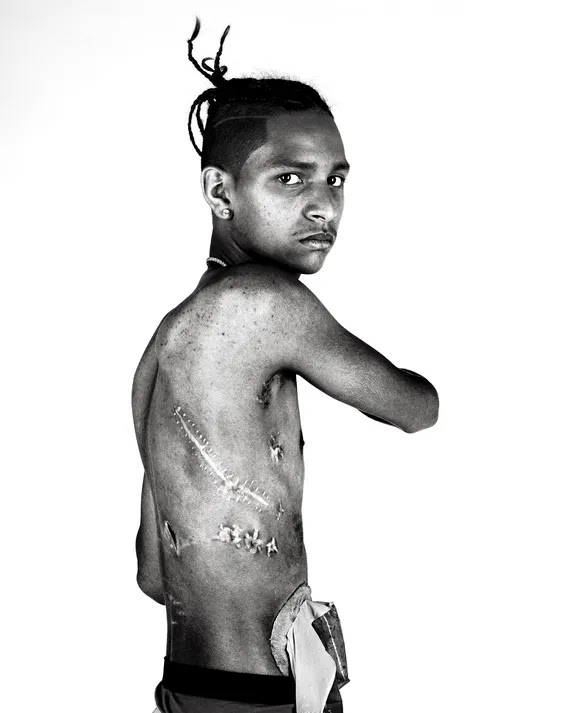
 
Since being shot five times, Parkland survivor Anthony Borges has worn a colostomy bag. Photo: Michael Avedon

In the wake of a deadly school shooting in Michigan, there have been a wave of shooting threats.

  1. In Dallas County, Alabama, three students were arrested for bringing three loaded guns to Southside High School. The students were arrested after investigators received an anonymous tip.

  2. In Mobile, Alabama, a 15-year-old was arrested for threatening to “shoot up” Mary G. Montgomery High School and Semmes Middle School. The teen posted the threat on Instagram.

(Jasmine Williams. “Students arrested for making threats, bringing loaded guns to Alabama schools.” WSAF 12 News. Montgomery. December 05, 2021.)

    3. A 17-year-old boy has been arrested in Michigan for bringing a loaded gun to a nearby      school. 

The teen was arrested for carrying a concealed weapon on Wednesday, December 1, at Southfield Regional Academic Campus, about 30 miles south of Oxford High School, after a classmate tipped off the principal, said Jeff Jagielski, a spokesperson for the Southfield Police Department

Southfield Police Chief Elvin Barren said the student is believed to have been bringing the Bersa Thunder 380 pistol to school for 'several weeks,' but insisted the student did not pose a threat to classmates or staff. 

"There was no indication that there was any type of copycat situation or any type of threats to the school, but rather a poor decision by this young man to not only carry a weapon but to carry a weapon onto school property,” Barren said. 

“The classmate told the principal that the teenager was known to carry a gun at school, but he did not know whether he had it with him Wednesday,” Jagielski said. “The classmate spoke up because of Tuesday's shooting at Oxford High School,” Jagielski said. 

“The principal alerted a school resource officer, who found the gun, loaded with three rounds, in the student's coat pocket,” Jagielski said. 

(Emily Shapiro. “Teen arrested for bringing loaded gun to Michigan school near this week's deadly shooting.” ABC News. December 02, 2021.)  

4. St. Louis police are investigating how a second-grade student was able to take a loaded handgun to school and show it off to his classmates during recess, authorities said. 

The incident at Pamoja Preparatory Academy is the latest involving minors taking guns to schools — and follows by about a week the mass shooting at a Michigan high school in which four students were killed and several others injured.

Kylie Vardiman, a second-grade student who was playing with her friends at recess, told St. Louis Fox affiliate KTVI that she was “shocked” when she saw a second-grade male classmate with the gun Friday afternoon. 

George Sells, a spokesman for St. Louis Public Schools, told The Washington Post that a teacher “picking up on unusual behavior found the weapon and took action” to immediately secure the gun without anyone getting hurt.

But when police arrived, authorities concluded that no charges would be brought against the child’s family. Police said the boy found the gun “in a lock box under his parent’s bed” and had no intention of harming classmates and teachers.

(Timothy Bella. “A second-grader showed off a loaded gun at recess, police say. Then classmates told a teacher.” The Washington Post. December 07, 2021.)

February 14, 2018: Marjory Stoneman Douglas High School | Parkland, Florida | 17 Killed, 17 Injured. From left, Samantha Fuentes, Ashley Baez, Isabel Chequer, William Olson, Anthony Borges, and Alexander Dworet. Photo: Michael Avedon

What kind of lunacy is taking place in our schools?

Some students are coming to school with weapons – even firearms. Violence and the gun culture have an evil and deadly grip on our nation. Now, public school students turn to weapons to settle disputes and take out their aggression. Schools are forced to take new precautions to prevent tragedies and mass shootings.

Doesn't the recent news beg the question: Just how prevalent are weapons in American high schools? Let's explore that question.

What if I told you that statistics say – in general and not considering the location of the school – 3 in every 100 students in grades 9-12 have carried a weapon such as a gun, knife, or club on school property in the previous 30 days? Would that be cause for alarm?

According to data from the Youth Risk Behavior Surveillance System (YRBSS) and National Center For Education Statistics (Last Updated: May 2021) – in 2019 the percentage of students in grades 9-12 who reported having carried a weapon on school property at least 1 day during the previous 30 days was 3 percent overall, and it ranged from 1 percent in Pennsylvania to 9 percent in Alaska.

The percentage of students in grades 9–12 who reported carrying a weapon anywhere during the previous 30 days decreased from 17 percent in 2009 to 13 percent in 2019. Similarly, the percentage of students who reported carrying a weapon on school property during the previous 30 days decreased from 6 to 3 percent during the same period.

Considering student weapon carrying on school property by frequency, more than 1 percent of students (1.4 percent) reported carrying a weapon on 6 or more days, and less than 1 percent (0.7 percent each) reported carrying a weapon on 2 to 5 days and on 1 day during the previous 30 days.

(These figures are explained. In the YRBSS, students in grades 9–12 were asked if they had carried a weapon such as a gun, knife, or club anywhere during the previous 30 days and if they had carried such a weapon on school property during the same time period. In this indicator, the percentage of students carrying a weapon “anywhere” is included as a point of comparison with the percentage of students carrying a weapon on school property.)

(“Students Carrying Weapons on School Property and Anywhere and Students’ Access to Firearms.” Annual Reports and Information Staff. National Center For Education Statistics. May 2021.)


Besides student-reported data on carrying a weapon, states also report data on public school students’ possession of weapons – specifically firearms – at school. As part of the EDFacts data collection – a U.S. Department of Education (ED) initiative – state education agencies report the number of public school students from kindergarten to 12th grade known to have brought firearms to or possessed firearms at school. State education agencies compile these data based on student counts that were reported by their schools and school districts.

During the 2018–19 school year, about 2,900 public elementary and secondary students were reported to have possessed firearms at schools in the United States. This translates to an overall rate of 6 per 100,000 students who possessed firearms at school. When the rates are examined by state, the data reveal that the majority (45 states and the District of Columbia) had rates between 1 and 20 per 100,000 students. Three states – New Jersey, Missouri, and Idaho – had rates below 1 per 100,000 students, while two states had rates above 20 per 100,000 students: Louisiana and Arkansas.

Note the difference in statistics. When students report about carrying weapons on school property, the percentages are much higher (3 in 100) than when states report the numbers of firearms (6 in 100,000).

However, some stats are even more alarming.

A report on October 27, 2021, says school weapons busts in New York City have shot up by 28 percent this school year compared to the same stretch during the last pre-COVID academic term, according to new NYPD numbers.

(Selim Algar and Tina Moore. “NYC schools see 28 percent spike in weapons seizures.” New York Post. October 27, 2021.)

An increase in gun incidents is occurring nationwide. The National Association of School Resource Officers reports that from August 1 to October 1 this year (2021), there were 97 reported gun-related incidents in schools. During the same span in 2019, there were 29.

Similarly, Everytown for Gun Safety, a lobby group for gun restrictions, tallies 56 instances of gunfire on school grounds in August and September of 2021. That is higher for those two months than any year since the group began tracking incidents in 2013, and more than double the previous high of 22 in 2019. It also found record numbers of deaths, at eight, and injuries, with 35.

“School violence has risen to levels that we haven’t seen quite frankly,” said Mo Canady, executive director of the National Association of School Resource Officers. “I don’t think it took a genius to see this coming.”

“The toxic stress of everything going on during the pandemic, it’s building up with kids — and adults. Now that they’re around each other again, they need to relearn how to do school again,” said Christina Conolly, director of Psychological Services for Montgomery County Public Schools in Maryland, who recently chaired the School Safety and Crisis Response Committee of the National Association of School Psychologists.

(Laura Mecklerand Valerie Strauss.”Back to school has brought guns, fighting and acting out.” The Washington Post. October 26, 2021.)

One study says guns at school have gone gonzo.

According to Steven Reinberg, health reporter for Web MD, a 2019 study of nearly 180,000 high school students by Emmy-award winning journalist and physician Mallika Marshall, MD and reported in the Journal of Pediatrics shows that 1 in 18 U.S. Teens carries a gun to school. That's nearly 1 million teens taking a potentially deadly weapon to school. But researchers say universal background checks can put a dent in those numbers.

While gun-toting teens were found in every state, 83% were in states that did not have universal background checks, the research team found.

Federal background checks by themselves didn't reduce the number of teens carrying guns, the researchers reported. Similarly, state background checks weren't effective on teen gun-carrying until after the federal system was implemented.

Background checks were most effective when they could quickly access "a national background check system containing complete criminal data on gun buyers," lead researcher Teresa Maria Bell noted.

(Steven Reinberg. “1 in 18 U.S. Teens Carries a Gun to School: Study.” Web MD. Dec. 2, 2019.)


Seeking Real Understanding

So what's the truth about the prevalence of carrying a weapon – gun or otherwise – on campus? An article from PBS in 2018 attempts to explain not only why statistics are difficult to obtain but also how incidents are likely under-reported.

When a student is caught with a gun at school, the 1994 Gun-Free Schools Act requires schools to report the incident to the school district, which is supposed to pass the information along to state education officials, who then are supposed to send it to the U.S. Department of Education. The idea behind the reporting requirement is to make it possible to detect trends and inform policymakers as they seek to address the problem.

PBS reports in the past few years, school and state officials have not properly tracked deadly school shootings in Arizona and Colorado, and firearm-related school incidents in Maine. State education officials there say that while they collect statistics, they don’t enforce the reporting requirement.

PBS believes such incidents are grossly underestimated. For example, in Iowa, 15 firearm incidents were recorded in 2015-16. Only one shows up in the federal database. Iowa education officials did not respond to a follow-up question about why the state and federal data are different.

Kenneth Trump, president of National School Safety and Security Services, an Ohio-based school safety consulting firm, said, “With no nationally enforced reporting system, schools’ reporting is a 'goodwill effort.'”

High school students clearly are bringing guns to schools at a much higher rate than is characterized by the federal data.

(Jen Fifield. “Nobody knows how many kids get caught with guns in school. Here’s why.” PBS News Hour. March 05, 2018.)


Student Profile From the Statistics

A higher percentage of male students (4%) than of female students(2%) in grades 9–12 reported that they had carried a weapon on school property during the previous 30 days.

The percentage was lower for Asian students (1 percent) than for Hispanic students (3 percent), students of Two or more races (3 percent), Black students (4 percent), and American Indian/Alaska Native students (11 percent). This percentage was also lower for White students (2 percent) than for Black students and American Indian/Alaska Native students.

The percentages of students who reported carrying a weapon on school property during the previous 30 days were higher for students who were not sure about their sexual identity (7 percent) and who were gay, lesbian, or bisexual (4 percent) than for students who were heterosexual (2 percent). A higher percentage of 11th-graders than of 9th-graders reported carrying a weapon on school property during the previous 30 days (3 vs. 2 percent).

In the SCS survey, students ages 12–18 were asked if they could have obtained a loaded gun without adult permission, either at school or away from school, during the current school year. In 2019, about 4 percent of students ages 12–18 reported having access to a loaded gun without adult permission during the school year, either at school or away from school; this was lower than the percentage reported in 2009 (6 percent).

In every survey year from 2009 to 2019 (except in 2013 when there was no measurable difference), a higher percentage of male students than of female students ages 12–18 reported having access to a loaded gun without adult permission, either at school or away from school during the school year.

When differences are examined by school characteristics, the data show that a higher percentage of students enrolled in schools in towns (9 percent) reported having access to a loaded gun without adult permission, compared with their peers enrolled in schools in cities and suburban areas (3 percent each); the percentage was also higher for students enrolled in schools in rural areas (5 percent) than for those enrolled in schools in suburban areas. In addition, a higher percentage of public school students than of private school students reported having access to a loaded gun without adult permission in 2019 (4 vs. 1 percent).

(“Students Carrying Weapons on School Property and Anywhere and Students’ Access to Firearms.” Annual Reports and Information Staff. National Center For Education Statistics. May 2021.)

What Is the Solution?

Between 2000 and 2013, the FBI studied pre-attack behaviors of active shooters in schools. Their findings are detailed and extensive, but here’s a quick list of things to watch for, based on what they found:

  • 55% of school shooters had made threats or had a confrontation with their target. This could mean a teacher or their peers.

  • 62% of school shooters struggled with mental health issues. While it is often impossible to determine whether or not someone is dealing with mental illness, it is still something to be aware of.

  • 90% of school shooters showed signs of suicidal ideation and 23% attempted suicide before a shooting.

  • 88% of active shooters under the age of 17 communicated an intent to commit violence, either verbally or on social media.

(James Silver Ph.D et al. “A Study of Pre-Attack Behaviors of Active Shooters in the U.S. Between 2000 and 2013” U.S. Department of Justice. Federal Bureau of Investigation. June 2018.)

Another study by the Secret Service's National Threat Assessment Center is one of the most comprehensive reviews of school attacks since the Columbine shootings in 1999. The report obtained by The Associated Press looked in depth at 41 school attacks from 2008 through 2017.

(Lina Alathari, Ph.D. Cheif.“Protecting America's Schools/Analysis Of Targeted School Violence. National Threat Assessment Center. U.S. Secret Service. U.S. Department of Homeland Security. November 2019.) 

The report said incidents of targeted school violence are preventable when communities identify and act on the warning signs.

"That should involve teachers, counselors, administrators, principals and school resource officers. Everyone has a role to play in prevention," said the report's author Lina Alathari, a psychologist who leads the agency's National Threat Assessment Center.said.

"They let other students know, and those around them, about their planning,"said Alathari. "They talked about wanting to carry out an attack. They selected dates and so on."

Among the warning signs, the report said, are a fascination with past violent attacks, an interest in weapons, suicidal thoughts and harassing behavior. Nearly half the plotters in the analysis were found to have been bullied by their classmates.

The Secret Service said that in many cases, students plotted their attacks for months, allowing ample time to stop them if schools know what to look for. In the 21 cases where a date for the earliest planning was found, 14 were planned for at least a month, with one student considering an attack for more than two years.

The level of planning can be quite detailed, Alathari said.

"There were students who were manufacturing explosives," she said. "They were doing research on websites on how to maximize casualties and how to acquire weapons."

While it’s difficult to pinpoint why gun violence in schools is increasing, law enforcement experts believe they know the primary reason: diminished coping skills.

“We have kids who are so isolated inside,” Mike Clumpner, a police officer who specializes in active shooter training says, “they don’t learn those problem-solving skills.” Isolation happens in many ways: they’re glued to technology or perhaps their parents and caregivers are the ones sucked into a screen. They don’t learn coping and conflict resolution skills, so when they get angry, they lash out in violent ways.

Depression is one the largest contributing factors, Reid Meloy, a forensic psychologist explains. Depression is often the first symptom of isolation. Most, but not all, shooters suffered from depression and/or paranoia, particularly those who were adolescents. While we can’t blame mental health issues for school shootings, they are a risk factor.

These mental health issues for our students often occur because of childhood trauma, but also marginalization. The U.S. Secret Service and U.S. Department of Education found that nearly 75 percent of school shooters were bullied or harassed at school. In other words, the isolation of our students doesn’t just come from video games and technology, it also comes from their peers.

Alfred University conducted a survey of American students on school shootings. 61 percent of the respondents said they know students who could bring a gun to school if they wanted to. The top reason they gave for a school shooting: “They want to get back at those who have hurt them.” Eighty-seven percent of students cited this as the reason.

(Edward Gaughan, Ph.D et al. “Lethal Violence in Schools.” Alfred University. August 2001.)

(“Can School Shootings Be Prevented?” SaferWatch – web and mobile security. April 06, 2021.)


"Louie Louie" -- Long Live Garage Bands


Three nights and days I sailed the sea

Me think of girl constantly

On the ship, I dream she there

I smell the rose in her hair

Louie Louie, oh no, me gotta go, yeah, yeah, yeah, yeah, yeah, baby

I've written about “Louie Louie” before. The history of this popular tune is extensive to say the least. Online you will find volumes of information about the song. There are even books written about the evolution and history of “Louie, Louie.” In addition, you can purchase entire albums of various renditions of the song. What is it about “Louie Louie” that is so special? 

Click here for the Wildly Considered companion piece on "Louie Louie": https://allthingswildlyconsidered.blogspot.com/2013/07/me-gotta-go-just-singing-louie-at-top.html 

Now, I don't claim to be a music historian, but I have a long love of the music, both collecting rock recordings and studying rock's cultural influence. I have listened to the genre since my early childhood. In addition to collecting music from an early age – progressing through 45s, albums, 8-tracks, cassettes, and compact discs – I have also spent decades working weekends as a mobile disc jockey. I possess an extensive collection of recordings that trace rock from its very early days. Suffice it to say, my lifelong passion is rock music.

I am here to profess once more that I believe no song inspired so many American garage bands as the Kingsmen's “Louie Louie.” For novices, a garage band is generally defined as “an amateur rock band typically holding its rehearsals in a garage and usually having only a local audience.” Of course, the garage can be a metaphor for any place where the band rehearses and records.

This song launched so many bands in its very simplicity. The three-chord, lo-fi makeup of the song served as the template for garage rock. Simple to play with a catchy refrain, “Louie Louie” gave teens that desired balance between burning passion and their still-developing musical ability. Raw and primitive, the song simply fit the appeal of garage bands. Every garage band of the 60s knew the song and played it at their gigs mainly because of audience demand.

In their own renditions, garage bands added their own elements to the classic such as four or five "yeahs" after "me gotta go.” They learned to play the dominant chord as a minor and included the famous pre-guitar solo exhortation "Let's give it to them right now!” The lyrics I remember – including those from our own garage band, Campbell's Pork and Beans – were made up as a mixture of suggestive double entendre verses, each extending the message of getting it on.

The late musical genius Frank Zappa, who lauded the original Richard Berry version, explained his love/hate relationship with the song …

“I don’t think the typical rock fan is smart enough to know he’s been duped, so it doesn’t make any difference … Those kids wouldn’t know good music if it came up and bit them on the ass. Especially in terms of a live concert where the main element is visual. Kids go to see their favorite acts, not to hear them. We work on the premise that nobody really hears what we do anyway, so it doesn’t make any difference if we play a place that’s got ugly acoustics. The best responses we get from an audience are when we do our worst material.

“It’s true man. 'Louie Louie' brings the house down every time …

“I played the gig [with the Soul Giants] for a while, and one night I suggested that we start doing original material so we could get a record contract. Davy [Coronado] didn’t like the idea. He was worried that if we played original material we would get fired from all the nice bars we were working in. The only things club owners wanted bands to play then were Wooly Bully, “Louie Louie” and In The Midnight Hour, because if the band played anything original, nobody would dance to it, and when they don’t dance, they don’t drink.

“When a guest conductor comes to town, he is not usually giving a performance of something by a living composer – because he can warm it up in one afternoon and make it sound okay. This makes the accountants happy, and allows the audience to concentrate on his choreography (which is really why they bought the tickets in the first place). Why is that any better than a bunch of guys in a bar band jamming on “Louie Louie” or Midnight Hour?”

(Frank Zappa. The Real Frank Zappa Book. Autobiography. 1989.)

Eric R. Danton, who writes about music and pop culture and whose work has appeared in The Wall Street Journal, Rolling Stone, The Boston Globe, Fortune, Paste, Pitchfork, Inside Hook, Salon, Flavorwire, Myspace, M Music & Musicians calls “Louie Louie” a “masterpiece built around trebly guitar, blaring organ and singer Jack Ely’s murky vocals – released in 1963, The Kingsmen’s cover of Richard Berry’s tune took the Portland, Oregon, band to No. 2 on the Billboard Hot 100 singles chart, where the song spent six weeks on its way to becoming eternal.”

Richard Berry wrote and recorded the original version of “Louie Louie” (released in 1957). It was the first-person story of a Jamaican sailor returning to the island to see his lover and based on a Latin song called “El Loco Cha Cha” that Berry had heard while he was backstage at a show.

Richard Berry was a respected member of the Los Angeles doo-wop music community that included Jesse Belvin, Cornel Gunter, Curtiss Williams and Gaynel Hodge, among others. Before he had ever written the song that many would claim as the ultimate party song, Berry provided the uncredited lead vocal for the original recording of Leiber and Stoller’s “Riot In Cell Block #9” with the Robins, which later evolved into the Coasters. He also contributed the male counterpart voice for Etta James’ recording of “Roll With Me, Henry” (a song with its own share of controversial innuendoes), which was written as an answer to Hank Ballard’s “Work With Me, Annie.”

(Eric Predoehl. “A Short History of the Song “Louie Louie.” The Louie Report. 1996.)

Performing well on the West Coast, Berry's version was a regional hit, but not a national smash. He wound up selling the copyright for $750 in 1959 to pay for his wedding.

Historical Note:

Here is a happy note. In the mid-1980s, Richard Berry was living on welfare at his mother's house in South Central Los Angeles. Drinks company California Cooler wanted to use "Louie Louie" in a commercial, but discovered it needed Berry's signature to use the song. The company asked the Artists' Rights society to locate him, and a lawyer visited Berry. The lawyer mentioned the possibility of Berry's taking action to gain the rights to his song. The publishers settled out of court, making Berry a millionaire.

(Martin Kelner. "Louie, Louie. Oh, oh . . .: Until a soft drinks company tracked him down, Richard Berry was living on welfare in the slums of LA". The Independent. October 21, 1993.) 


The Kingsmen recorded “Louie Louie” in 1963. At this point, Richard Berry’s original song had been covered hundreds, probably thousands of times, and yet, it’s still this 1963 Kingsmen's take that’s the most well-known, right down to the guitar solo.

Irony upon irony? The Kingsmen's version cover is, objectively, terribly produced. It's pretty much a terrible recording at a cheapskate studio – home of the small Jerden label, before being picked up later by the larger Wand Records. The entire recording session is marred by amateurism. The band were teenagers. The lead singer wore braces. In the middle of the recording, the drummer drops his drumsticks and seems to yell the “F-bomb.” (Try to hear it in the mix though – it's not really discernible.)

Oh, there's more – the recording engineer Robert Lindahl was aghast at the racket: "You're going to blow up my equipment!" The band locked him out of the booth until they had a take. They then learned that they were to pay for the session themselves and after each member stumped up ten dollars, they went back to their homes.

A chaotic guitar break is triggered by the shout, "Okay, let's give it to 'em right now!" That first appeared in the Wailers' version, as did the entire guitar break (although, in the Wailers' version, a few notes differ, and the entire band played the break).

Critic Dave Marsh suggests it is this moment that gives the recording greatness: "[Ely] went for it so avidly you'd have thought he'd spotted the jugular of a lifelong enemy, so crudely that, at that instant, Ely sounds like Donald Duck on helium. And it's that faintly ridiculous air that makes the Kingsmen's record the classic that it is, especially since it's followed by a guitar solo that's just as wacky.”

("Love That Louie - The Louie Louie Files (CD)". Bear Family Records. 2002.)

Yet, it turns out that terribleness and the chaos were great authentic features, not bugs. The Kingsmen’s cover of “Louie Louie,” became legendary partly because people initially thought the song was obscene. The truth was that the lyrics were so incoherent that they didn’t actually know what the singers were saying.

In the long run, it was the vast influence of the song that mattered most. "Louie Louie" became a record that inspired thousands of kids to pick up guitars and drum sets and bang their hearts out (much to the dismay of many a parent) in the basement or garage of their family home. Listen to the song's three-chord opening riff – could any rock riff be more famous? (Although the Stone's “Satisfaction” runs a distant second in my mind.)

The song was a commercial success; however, it was held out of the top spot on The Billboard Hot 100 Singles Chart by “The Singing Nun,” Jeanne-Paule Marie "Jeannine" Deckers, with her "Dominique,” a French language popular song. That's right – a French lyric song about a traveler who sings “a little song, never asking for reward – He just talks about the Lord.” It was '63, still a time of relative innocence. Soon, all of that would change.

“Louie Louie” did manage to earn a #1 showing in both Cash Box and Record World as well as in the hearts of almost every teenager growing up during this era.

A few weeks later The Beatles – and the British Invasion – would hit, wiping out virtually everything domestic from the charts, but, despite this new focus on all things British, The Kingsmen managed to have a few more hits: their version of the Motown classic (also covered by The Beatles) "Money" (#16, 1964); "Little Latin Lupe Lu" (#46, 1964); "Death Of An Angel" (#33, 1964), the novelty hit "The Jolly Green Giant" (#4, 1965); "The Climb" (#39, 1965) and "Annie Fanny", an "Alley Oop" clone (#29, 1965).

But, let's concentrate on that influence of “Louie” a little more

"Louie Louie" is the world's most recorded rock song, with published estimates ranging from over 1,600 to more than 2,000. It has been released or performed by a wide range of artists from reggae to hard rock, from jazz to psychedelic, from hip hop to easy listening. At the headquarters of LOUIELOUIE.NET, they've done their best to document all known recordings, but the site says it's a major challenge to keep up with all the variations.

The Kingsmen version in particular has been cited as the "rosetta stone" of garage rock, the defining "ur-text" of punk rock, and "the original grunge classic.” The influential rock critics Dave Marsh and Greil Marcus believe that virtually all punk rock can be traced back to a single proto-punk song, “Louie Louie.”

All of that fame is documented, by the way …

Azerrad, Michael (2010) [April 16, 1992]. "Seattle: An Inside Tour of the Decade's Greatest Scene". In Rolling Stone (ed.). The '90s: The Inside Stories from the Decade That Rocked. New York: Harper Collins. ISBN 978-0061779206.

Kallen, Stuart A. (2012). The History of Alternative Rock. San Diego: Lucent Books. p. 12.

Palao, Alec (2019). “Love That Louie” (CD sleeve notes). Various Artists. London: Ace Records.

Sabin, Roger (1999). Punk Rock: So What?: the Cultural Legacy of Punk. London: Routledge. p. 157.

Predoehl, Eric (November 10, 2008). "Little Bill & the Bluenotes (2008) – LOUIE of the Week". Santa Cruz, CA: louielouie.net. Retrieved September 30, 2019.

Then, there's the LOUIE LOUIE Advocacy and Music Appreciation Society (LLAMAS) formed in early 2007 by a group of musicians, fans and collectors with a particular (and in some cases obsessive) interest in the song.

The mission of LLAMAS is to:

  • Foster awareness of the unique role that the song LOUIE LOUIE has played in the history of popular music;

  • Promote an ongoing appreciation and popularity of LOUIE LOUIE; and

  • Encourage musical education and a broader appreciation of music through the amazing variety and creativity that has been demonstrated in the many, many different versions of LOUIE LOUIE; in almost every musical style imaginable.

Among other things, the society promotes the observance of International "Louie Louie" Day each year on April 11 and encourages artists to record and make available new versions of the song.

The City of Tacoma held a summer music and arts festival from 2003 to 2012 in July named LouieFest. The event began in 2003 as the "1000 Guitars Festival" and featured a group performance of "Louie Louie" open to anyone with a guitar.

Peoria, Illinois has held an annual "Louie Louie" street parade and festival every year since 1988.

A sculpture titled "Louie Louie, 2013" by Las Vegas-based artist Tim Bavington is displayed on the lobby wall of the Edith Green - Wendell Wyatt Federal Building in Portland, Oregon. The work is constructed of 80 colored glass and acrylic panels representing the waveforms of the song using Bavington's concept of sculpting sound waves.

Here is a brief summary of some of the "Louie Louie" rankings and recognitions in major publications and surveys …

Rock & Roll Hall of Fame

Songs That Shaped Rock and Roll

National Academy of Recording Arts and Sciences

Grammy Hall of Fame

National Public Radio

The 300 Most Important American Records of the 20th Century

NEA and RIAA

Songs of the Century

Rolling Stone Magazine

40 Songs That Changed The World

Mojo Magazine

Ultimate Jukebox: The 100 Singles You Must Own

The Wire Magazine

The 100 Most Important Records Ever Made

“Louie Louie” Spawns Garage Bands

Just some of the Portsmouth area bands of the past:

Del Rhythm's (mid 60's) : Cokie Caudill, Lee Albrecht, Gary Billips, Barry Slattery, Gary Dazer


Blended Foam (1968): Pete Costas. John Pollitt. Shane Keister


The Dukes of Wellington: Spencer Cunningham, Ron Leichner, Rich Cunningham, Mike Virginia, Ron Leichner?


The Blokes: Ken Cogan, Mike Casey Ron Millhuff 


Canterfield Canoe: Jeff Russell on bass, Pam Pack Partlow on flute, Randy Perkins on drums, Steve Smith on sax, Bill Gemperline on guitar and Butch Montavin on guitar


The Hustlin' Soul Brothers: Jerry White took the mike off the stand and lept into the air landing on the floor below in a split. Then to rise back up to a standing position without missing a beat. George Musser on bass and Trent Taylor on guitar. Andy Turner on drums? James Hamilton played keyboard, Huey "Big Man" Greene on the mean tambourine


Bare Facts: from left to right Ron Pruitt,Bill Maple(not in the original Facts),Boyd Williams, Russ Pruitt, Randy Boldman, and Dave Craycraft


The Outcasts (1965): Joseph Ray Ferguson - guitar (AKA Joey Ray), Jerry Rollins - Lead Singer, Terry Stevenson - Drums, Jim Pennywitt - Lead Guitar, John Oakley - Bass Guitar


The Night Shift Band: Josie Fagan, Mike Craft, John Blevins, Steve Hacker, Don Smith


Purple Reign: (from L to R) Ron Hadsell (vocals, trumpet), Jeff Cisler (all around sub in the band. had his own band Mahogany Fantasy around the same time), Owen Thompson (keys), David Cisler (guitar, vocals), Pixie Mader (vocals), Rod Risner (drums), Mike Schoonover (guitar) and Mike Ramey (bass)


Rampagers (shot at Leadingham Studio in New Boston circa 1965): Ronnie Clay (RIP), Ron Conley, Steve Hornicle, Jack Gillum & Bill Tatman. 


Summer Breeze: Bobby Maple, Cokie Caudill, Danny Ratliff, Tina Pack, Marilyn Phipps 


Hit & Run: Terri Montgomery, Danny Ratliff, Doug Parsley, Bob Evans and Ron Hadsell


Flint: Donnie Eubank, Tim Odle, Billy Massie, Jaime Vendera, Gordy McPhail

Thanks to "Portsmouth Rock & Roll Scrapbook" on Facebook: https://www.facebook.com/groups/112994998723111


Monday, December 6, 2021

The "Disappeared" Of Mexico -- Food Keeps Their Memory Alive


“When people vanish in Sinaloa, they’re almost never seen again. Sometimes drug cartels are responsible; in other cases state security forces are. Often the two sides are colluding – Mexico’s police and military are notoriously corrupt. People are taken because they work for cartels or because they refuse to. Because they buy drugs, sell them, or get in the way of the business. Because they’re in criminal gangs or are believed to be. Because they might be worth a ransom. Because they’re simply in the wrong place at the wrong time.”

“More than 90,000 husbands, sons, and fathers, wives, daughters, and mothers haunt Mexico. They are los desaparecidos – the disappeared.”

(Annelise Jolley. “A Feast For Lost Souls” The Atavist Magazine, No. 121. November 30, 2021.)

Freelance writer and editor Annelise Jolley writes in The Atavist Magazine that “enforced disappearances” – the legal term for the abduction of individuals and the concealment of their whereabouts – have plagued Latin American countries for decades. The syntax of the problem is strained by necessity: People don’t disappear, which implies they have a choice in the matter. Rather, they are disappeared, by forces beyond their control.

In Mexico, more than 90 percent of disappearances have occurred since 2006, the year then president Felipe Calderón enlisted the military to fight drug cartels. Today a maelstrom of gang and cartel conflict, as well as government and police corruption, continues to sweep up civilians, most of them poor and male. Impunity exacerbates the problem: According to national figures, there were roughly 7,000 disappearances in 2019, but only 351 legal cases were opened. Of those, two were prosecuted.

One day a person is there, and the next they are gone. Their loved ones are left to search for something, anything, tangible to mourn.

The impulse to bury the dead is ancient. It may even predate our species: In South Africa, paleo-archaeologists discovered fossilized bone fragments of Homo naledi in deep, nearly inaccessible cave chambers, hinting that pre-humans as far back as 300,000 years may have deliberately laid one another to rest.

Jolley shares …

“Burial is seen as the final physical act of tenderness the living can offer the dead. It provides a sense of completion, of having accompanied someone as far down the road of life as we can go with them. Funerary rites enshrine stories of faith, love, and sorrow, and graves offer the grieving a place they can return to again and again.

“'Just as the living need places to inhabit, so it is often in the nature of our memory-making to wish to be able to address our dead at particular sites of the Earth’s surface,' writes Robert Macfarlane in his book Underland: A Deep Time Journey. 'The grief of those who have been unable to locate the bodies of their loved ones can be especially corrosive—acid and unhealing.'”

“This is the double cruelty of enforced disappearances: First comes the loss of a life, and then comes the denial of any chance to lay the body to rest.

“In Sinaloa, Mexico, women recover the bodies of missing loved ones—and cook to keep their memories of the dead alive.”

(Annelise Jolley. “A Feast For Lost Souls” The Atavist Magazine, No. 121. November 30, 2021.)

Jolley traveled to Sinaloa to meet a women-led collective determined to reclaim that chance. They call themselves Las Rastreadoras del Fuerte (The Trackers of El Fuerte), and they are part of a long legacy of civilian women leading campaigns to find Mexico’s disappeared.

Formed in 2014, Las Rastreadoras is one of these groups. It has some 200 members, most of them women from El Fuerte, a municipality in northern Sinaloa. They’ve all been touched in some way by enforced disappearances. Many have lost husbands or sons.

Jolley explains …

“Criminal groups across Mexico dispose of bodies in distinctive ways—some burn them, others dissolve them in acid. In El Fuerte, the disappeared tend to be buried in shallow unmarked graves in the countryside. So Las Rastreadoras search the landscape with basic tools: shovels, machetes, spades, picks. The women dig in the dry earth, knowing that to properly bury their dead, they must unbury them first.

They don’t call what they’re looking for bodies, corpses, or remains. To Las Rastreadoras, the dead are tesoros—treasures.”

(Annelise Jolley. “A Feast For Lost Souls” The Atavist Magazine, No. 121. November 30, 2021.)


Mexico is a country that feeds its dead. Every year, bottles of Fanta and plates of pan dulce and pollo con mole adorn altars on Día de Muertos (the Day of the Dead). Food is a way of remembering and honoring those who’ve passed away. For Las Rastreadoras, it has become something more.

The idea to compile a cookbook arose. Photographer Zahara Gómez Lucini had spent time documenting Las Rastreadoras, and together she and the women came to a realization: “The problem with a decades-long issue like los desaparecidos is that the public grows weary of it – of hearing the names of the missing, of fathoming their ever growing numbers, of seeing photos of bodies and watching mothers weep.” How, then, could Las Rastreadoras push back against the erasure of their loved ones? How could the women resist oblivion?


Food was the answer. All the women had memories of their missing that were tied to cooking and eating. They decided to gather recipes for the dishes their loved ones had enjoyed most. They would invite cookbook readers to taste their loss. The recipes would be reminders of the bonds the dead shared with family and friends, of the tables they sat around, of the pleasure they took in eating. The dishes would be proof of lives lived and lost, and portals to empathy.

“Feasting allows the loneliness and terror of existence to be forgotten, at least momentarily,” anthropologist Gina Rae La Cerva has written. “Such pleasure brings us into that raw, mad, deep love of life.” Feasting can also be a venue for the sharing and salving of pain.

Recetario para la Memoria (“The Memory Recipe Book”) was published in 2019. In addition to the recipes, it features Zahara’s images of Las Rastreadoras preparing meals – of women creating the means of their physical and emotional survival. Many of them were photographed cooking their chosen dishes for the first time since their loved ones were disappeared.

(Annelise Jolley. “A Feast For Lost Souls” The Atavist Magazine, No. 121. November 30, 2021.)

Fifty percent of the proceeds from each book purchased go directly to the Rastreadoras. Each of the thirty dishes in the book speaks through its local ingredients and flavors, and is named after the loved one to whom it is dedicated. 

Take, for instance, “Las Pizzadillas Para Roberto” – a type of quesadilla made with braised beef and shredded cheese that is accompanied by refried beans, salsa, and a cucumber-lettuce salad. “It’s very simple, but it was my son’s favorite,” Mirna Nereida Medina Quiñonez explained in an interview. “He called them ‘pizzadillas’ (‘little pizzas’) because I’d use two tortillas, instead of just folding one in half. Then, my son would cut it into four pieces, just like pizza slices.”

(Sabrina Mandanici. “Zahara Goméz Lucini, Recetario para la memoria.” Collector Daily. April 15, 2021.)


Historical Note:

The Day of the Dead (el Día de los Muertos), is a Mexican holiday where families welcome back the souls of their deceased relatives for a brief reunion that includes food, drink and celebration. A blend of Mesoamerican ritual, European religion and Spanish culture, the holiday is celebrated each year from October 31-November 2.

The roots of the Day of the Dead, celebrated in contemporary Mexico and among those of Mexican heritage in the United States and around the world, go back some 3,000 years, to the rituals honoring the dead in pre-Columbian Mesoamerica.

While October 31 is Halloween, November 2 is All Souls Day or the Day of the Dead. According to tradition, the gates of heaven are opened at midnight on October 31 and the spirits of children can rejoin their families for 24 hours. The spirits of adults can do the same on November 2.

Conclusion

“They lie in clandestine graves strewn across the desert, mingled in communal pits, or hacked to pieces and scattered on desiccated hillsides.

“Buried without a name, often all that’s left once their bodies are gone are the empty casings of a person: a bloodied sweatshirt, a frilly top, a tattered dress.

“All over Mexico, mothers wander under the scorching sun, poking at the earth and sniffing for the tell-tale scent of decomposing flesh, hoping for a scrap that points toward their missing son or daughter.

“For most, the answers never come.”

(Oscar Lopez. Photographs by Fred Ramos. “Gone.” The New York Times. October 03, 2021.)

Government officials won praise from human rights advocates when they announced a plan in late 2019 to assemble a team of national and international experts with the aim of identifying all the bodies and even bone fragments.

The latest setback has been COVID-19, which has officially killed nearly 200,000 people in Mexico.

“The expectation, generally, was that the subject of disappearance and of identifications would be one of the top priorities of the federal government,” said Humberto Guerrero Rosales, a member of a citizens advisory board on the issue formed in 2018. “But then came a global pandemic.”

Notwithstanding Covid-19, 2019 showed a record 34,648 murders in 2019.

The effort has stalled amid the COVID-19 pandemic and the realization that the forensic challenges are more daunting than anticipated.

“Few cemeteries — almost none — have a good registry of the location and quantity of people who are buried there,” said Roxana Enríquez Farias, a founder of the Mexican Forensic Anthropology Team, a nonprofit that has aided with state-level exhumation plans.

(Maya Averbuch and Kate Linthicum. “Where are Mexico’s disappeared? Many have been in government graves all along.” Los Angeles Times. February 28, 2021.)

Awash in los desaparecidos amid the unbearable grief and the pain, Mexican people have Las Rastreadoras, Recetario para la Memoria, and their precious food. Mexican cuisine is a complex and ancient cuisine stemming from three main Mexican cultures: Mayan, Aztec, and Spain,

In 2010, Mexican cuisine was inscribed by UNESCO (the United Nations Educational, Scientific and Cultural Organization) on their Representative List of the Intangible Cultural Heritage of Humanity. UNESCO describes Mexican cuisine as “elaborate and symbol-laden,” and goes on to explain that this culinary tradition is exceptional in its ability to “express community identity, reinforce social bonds, and build stronger local, regional and national identities.”

Spanish-Argentinian photographer Zahara Gómez Lucini, whose work aims to explore violence from the memory of the territories that have suffered it, says …

“Let's allow the act of cooking to become an excuse to speak the unspeakable; to bring back those who have been taken away from us. Let's allow cooking to become a survival mechanism to face their absence.”

Readers, please remember Las Rastreadoras – who are mostly housewives in their 40s and 50s – literally scouring the nearby grasslands, deserts, and jungles with shovels in hands hoping to make a discovery – a bittersweet finding of a loved one they know as their “treasure.” 

Someone tell me if they have seen my husband,
Asked the madam.
His name is Ernesto X. He is forty years old.
He works as a caretaker, in a car dealership business.
He had a dark shirt and light pants.

He went out the night before last night and he has not returned
And I don't know what to think anymore,
Because this had never happened to me before.
Oooo...

Where do the disappeared go?
Look in the water and in the bushes.
And why is it that they disappear?
Because were are not all the same.

And when does the disappeared come back?
Every time you have him (or her) in your thoughts.
How do you talk to the disappeared?
With a gripping emotion inside you.

From "Desapariciones" (English Translation) by Rubén Blades. Album: Buscando America (Looking for America), 1984


Sunday, December 5, 2021

Rep. Thomas Massie: "Merry Christmas From Our Family Assault Team"


Why would someone – especially someone who holds the office of U.S. Representative – just days after a horrific school shooting in Michigan, post a tweet featuring a photo of himself and his family holding an arsenal of guns in front of a Christmas tree?

That is exactly what Thomas Massie did. Massie is a 50-year-old Republican who has been a United States Representative for Kentucky's 4th congressional district since 2012.

On Saturday, December 5, 2021, Massie tweeted a picture of himself and his family of six others holding “firearms resembling machine guns and semi-automatic weaponry, some of which had been made to look almost identical to fully automatic weapons.”

"Merry Christmas!" Massie said on Twitter. "Ps. Santa, please bring ammo."

Under US law, weapons such as machine guns are restricted to the military, law enforcement and civilians who have obtained special licenses for weapons made before May 1986.

The post received tens of thousands of "likes" as well as nearly 9,000 retweets and about 13,000 comments as of Saturday afternoon, including criticism of his timing.

Fellow Kentucky Rep. John Yarmuth, a Democrat, responded to the tweet …

"I promise not everyone in Kentucky is an insensitive a------."

"I'm old enough to remember Republicans screaming that it was insensitive to try to protect people from gun violence after a tragedy," he added. "Now they openly rub the murder of children in our faces like they scored a touchdown. Disgraceful."

(Jeremy Chisenhall. “‘Santa, please bring ammo.’ KY rep. condemned for posing with guns in Christmas photo.” Kentucky.com. December 05, 2021.)

Fred Guttenberg, an activist against gun violence, replied with a picture of his daughter, who was killed in the Parkland school shooting in Florida in 2018. "The Michigan school shooter and his family used to take photos like yours as well."

After receiving backlash, Massie retweeted a tweet from conservative political commentator Candace Owens, defending Massie’s tweet. “Can somebody explain to me how they worked out that the Michigan school shooting is (Massie’s) fault because he shared a picture of him and his family holding legal fire arms?” Owens asked in the tweet.

It should be noted that most critics of the tweet – including Yarmuth and Guttenberg – never claimed the shooting was Massie's fault.

(Bryce Shreve. “Disgraceful.' Rep. Massie draws bipartisan backlash for gun-filled Christmas photo.” Kentucky Spectrumnews1.com. December 05, 2021.)

Massie has been a strong supporter of gun rights.

Last January, Massie spoke to a cheering crowd at the state Capitol building in Frankfort, at one point waving his gun in front of the rallygoers. The Northern Kentucky congressman, who opened his speech by repeating the saying that God created man and Sam Colt – whose company led to the mass production of revolvers – made them equal, said it’s everyone’s God-given right to bear arms.

“Don’t tell me nobody wants to take your guns," he said. "There are people right here in Frankfort who want to take your guns.”

Ayana Archie of the Louisville Courier Journal reported …

“Massie has also condemned red flag laws, saying people would end up in jail over them. And he condemned universal background checks, saying they’re just the government’s way of tracking what kind of guns people have.

“He's made other controversial tweets in the past. In August, he posted – and then apparently deleted – a tweet that compared so-called vaccine passports to the identification numbers Nazis tattooed on people imprisoned during the Holocaust.

(Ayana Archie. “Kentucky Rep. Thomas Massie tweets pro-gun photo days after Michigan school shooting. Louisville Courier Journal. December 04, 2021.)

Roots Of the Current Insanity

Since the election of Donald J. Trump in 2016, gun advocates have beem emboldened to commit such heightened acts of insensitivity.

Trump was outspoken about his support for gun rights. He boasted that his two adult sons were avid hunters. One of his first policy papers was on the Second Amendment, writing that the “government has no business dictating what types of firearms good, honest people are allowed to own.” And he talked about his New York-issued license to carry a concealed weapon and suggested he was prepared to use it.

“Somebody attacks me, oh, they’re gonna be shocked,” Trump said during a speech in Tennessee in 2015, comparing any such attack to “Death Wish,” the 1970s vigilante movie, and repeatedly using his right hand to pretend to pull a pistol from his suit. “Can you imagine? Somebody says: ‘Oh, there’s Trump. He’s easy pickings.’”

(Manny Fernandez and Mitch Smith. “Gun Owners ‘Can Breathe Again’: Trump’s Win Emboldens Advocates.” The New York Times. November 22, 2016.)

Everytown For Gun Safety reports …

“Armed protests; a resurgent white supremacist movement; anti-government militias organizing; conspiracy theories brought to the mainstream; purposeful sowing of distrust in political institutions – the United States currently faces a confluence of dangerous challenges caused by groups and individuals on the extreme right. Gun rights fanaticism is the common denominator among all these challenges.

“Having tracked the gun lobby, in particular the NRA, for years, Everytown for Gun Safety Support Fund (Everytown), in this report, examines the role of the gun lobby in exposing broader audiences to the potentially radicalizing messaging of the far right, fanning the flames of anger and fear in those already radicalized, and advocating for lax gun laws that enable violent extremists to arm themselves. The report further discusses what the dangerous confluence of reckless rhetoric, gun lobby influence, and armed extremism means for our democracy, in particular the prospect for extreme-right violence around the upcoming election. Unfortunately, there are several examples of extreme-right violence in the recent past in which these conditions resulted in tragedy.”

(“Armed and Dangerous: How the Gun Lobby Enshrines Guns as Tools of the Extreme Right.” Everytown Research & Policy. 2021.)

In October 2018, Trump and his allies issued ominous warnings about the supposed threat posed by a “caravan” of migrants heading to the United States from Mexico. NRATV, then the propaganda arm of the National Rifle Association, parroted those lines: An NRATV host claimed that left-wing groups, Jewish billionaire George Soros, and the Venezuelan government were conspiring to send large numbers of migrants to the United States in order to influence the upcoming election.

(“NRATV Correspondent: Migrant Caravan Is ‘an Invasion under the Guise of Migration.’” Media Matters for America. October 19, 2018.)

Everytown reports …

“Eight days later, a white supremacist entered the Pittsburgh Tree of Life synagogue and opened fire on the congregation. During his shootout with police, the shooter told an officer, 'They’re committing genocide to my people. I just want to kill Jews.' In his final social media post, the shooter accused a Jewish nonprofit that aids refugees of 'bring[ing] invaders in that kill our people,' directly referencing a well-known racist and anti-Semitic conspiracy theory known as the replacement theory. His rampage killed eleven people and wounded six more, making the attack the deadliest on a Jewish community in US history.”.

(“Armed and Dangerous: How the Gun Lobby Enshrines Guns as Tools of the Extreme Right.” Everytown Research & Policy. 2021.)

The shooter’s affinity for conspiracy theories did not stop there. Associates recalled that dating back to at least the 1990s, he had harbored conspiratorial views about the government. For instance, he kept a shotgun at the door in case “the [United Nations] blue hats” came to get him or his guns. The gun lobby has for years promoted the conspiracy theory that the UN is planning to confiscate guns in the US.

(Rich Lord. “How Robert Bowers Went from Conservative to White Nationalist.” Pittsburgh Post-Gazette. November 10, 2018.)

The jacket for one of NRA CEO Wayne LaPierre’s two books about the subject reads, in part, “If you think there’s no way an armed U.N. platoon of blue helmets can knock on your door to take your guns, this book just became your next must-read.” Indeed, conspiracy theories about pending gun confiscation have been central to gun lobby and extreme-right messaging for decades. These conspiracy theories contribute to a dangerous climate among the extreme right that increases the prospect for violence.

(Wayne LaPierre. The Global War on Your Guns: Inside the UN Plan to Destroy the Bill of Rights. 2006.)

Concluding Remarks

Representative Thomas Massie has chosen to promote a dangerous holiday message that will likely increase the prospect for violence in a country struggling mightily with a gun violence epidemic. There is absolutely nothing redeeming about his tweet. It is neither appropriate nor purposeful. If anything, it openly attacks the spirit of Christmas and defies the message of “Glory to God in the highest, and on earth peace, good will toward men.

The frightening reality is that a United States congressperson would choose to make public his twisted gun mentality. Look at the firearms in the photo. These are not hunting rifles or weapons used to target practice for sport. The message is clear – the family is posing with aggressive weapons used to end human life. And … they want lots of ammo to do so.

Consider this tweet opposing Massie by a man named Samuel Sinyangwe …

“If a Black family posted something like this a SWAT team would raid the house and any family members who survived would be permanently added to a gang database.”

Sarcastic? Perhaps, but you know the truth in the statement. I don't have to support the veracity here. Like the boasts and forceful messages of so many others who want to force the issues involved in the 2nd Amendment, Thomas Massie's words and photo will get a free pass … he may possibly face a small lecture about bad timing for his sick message.

Damn him. This man has a gun fetish with an assault mentality and wants everyone to know it. If Massie is to continue to serve Kentucky, he should at least represent his district with the honor they deserve. It is my hope the good people of the state – both gun owners and others – demand better. The representation of his Kentucky family as a well-armed militia is more than misguided. It is divisive and dangerous.

I Could Ask, But I Think They Use Tweezers

the shoulder isllllllla complicated organlllllfemorallllllllllllllllartery lymphlllnodes tendons all those joints iflllllla bullet goes
thru you there’s alsolllllllthe clothingllllllllohlllllyeah what did you thinkllllllI mean if it’s just thisllllllllthen that’s different but
if it’sllllllltwo layers of thatllllthose are other impurities the bodylllllllllllllllllllllllllldoes it’s job just one
lllllllllllllllllllllllllllfunction to release what can’t stay he walked into the ER smiledlllllllllllllllllllllll“I need a doctorllllllthanks
lllllllllman” blood stops moving to the bigllllllllllllllllltowns the brain is a big town the heart is a big town the kidneys are
llllllllllllllllllllllhot spots like Vegas builtllllllllllllllllllllllllllllllllto handle armies on vacation the blood learnsllllto bend another
way like the legs of a cranelllllllllllllllllllllthey make bullets differentlllllllllllnow-a-daysllllllllllllllllllin thellllllllllllllgood-ole-days
llllllllla bullet went in and out andllllllllllllllllllllllllthe holes matched now alllllllllll.22llllllllllllla .38llllllexpands in the body
absorbs like a tamponlllllllllllllllfunctionlllllllllllllllllllllllllpull in all lifellllllllhe was ordering drive thru foodlllllllllllllMcDonalds
food notlllllllllllllllreally food maybe likellllllllllfrench fries maybe likelllllllllllla Sprite maybe like a #2
lllllllllllllllllllllllllllllllllllllllllllthings that don’t feel like food in the mornings downlllllllllllllllllllllllllthe street from my house
lllllllllllfrom his mama house a clogllllllllllllllllllllat the 3rd counter this guy has a gun a gun haslllllllllllllllllllllllllllllllllllllllan
operation has composition is orchestralllllllllllllllllllllllis an organ of some complication ephemeral
lllllllllllllllllllllllllllllllllllllllllthe bullets are small a shoulder is innocuous until you become a nurse the only
lllllllllllllllllllllllllllllllllllllllllllllllllreason he died was speed and proximity but if it’s a couplelllllllllllllllllllllllayers of cloth well you
have to get that out too

Aziza Barnes is blk & alive. Born in Los Angeles, Barnes currently lives in Oxford, Mississippi. Aziza’s first full length collection, “I be but i ain’t” is forthcoming from YesYes Books. Aziza is a poetry & non-fiction editor at Kinfolks Quarterly, a Callaloo fellow, a graduate from NYU’s Tisch School of the Arts, and a current candidate for an MFA in Poetry at University of Mississippi.

“I Could Ask, But I Think They Use Tweezers” grew from Barnes’ long struggle to find the language to talk about the murder of a friend. He was shot and killed at 18, just before he planned to train to be a firefighter. (She asked us not to share his name out of respect for his family’s privacy.)